



First, A Quick Earthly Refresher
To understand just how strange Venus is, let's quickly reset our brains to how things work here on Earth. We have two simple concepts: a day and a year. A day is one full rotation of our planet on its axis, taking about 24 hours. This is the time it takes
for the sun to appear in the same position in the sky. A year is the time it takes for Earth to complete one full orbit around the sun, roughly 365.25 days. We experience about 365 sunrises and sunsets in one trip around our star. This rhythm is the foundation of our lives, our calendars, and our biology. It’s simple, predictable, and makes intuitive sense.
Enter Venus: The Planet of Paradoxes
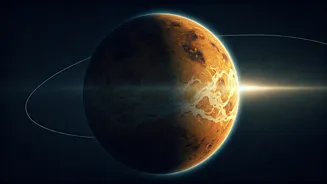
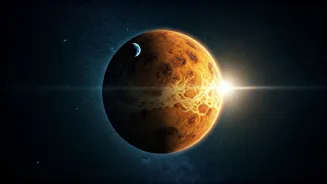
Now, let’s throw all that intuition out the window. Venus, our nearest planetary neighbour, operates on a completely different timescale. A year on Venus—the time it takes to orbit the sun—is about 225 Earth days. This is shorter than Earth’s year, which is unsurprising as it’s closer to the sun. But here’s where it gets weird. A single day on Venus, measured as one full rotation on its axis, takes a staggering 243 Earth days. Yes, you read that correctly. A single spin of the planet (its sidereal day) is longer than its entire year. If Venus had an office-based work culture, you could start your work week on Monday, complete an entire year's worth of reports, and it would still be Monday.
The Slow, Backward Spin
So, why is Venus so sluggish? The answer lies in its bizarre rotation. Most planets in our solar system, including Earth, spin on their axis in the same direction they orbit the sun (counter-clockwise if you’re looking down from above the sun’s north pole). This is called prograde rotation. Venus, however, spins backward. It has a retrograde rotation, spinning clockwise. Not only does it spin backward, but it does so incredibly slowly. Scientists are still debating the exact cause. One leading theory suggests that a massive collision with an asteroid or another planetary body early in its history may have knocked it off-kilter, slowing its spin to a crawl and eventually reversing it. Another theory points to a tug-of-war between the sun's immense gravity and Venus's thick, heavy atmosphere, which may have created an atmospheric tide that effectively acts as a brake on the planet's rotation over billions of years.
But Wait, What About Sunrise?
This is where the story takes another strange turn. We’ve established that a rotational day (one 360-degree spin) is 243 Earth days. But a 'day' can also mean the time from one sunrise to the next. This is called a solar day. Because Venus is rotating backward while it moves forward in its orbit around the sun, these two motions work against each other in a unique way. The effect is that the time between sunrises is actually much shorter than the planet's rotational period. One solar day on Venus is about 117 Earth days. This means that if you were standing on the surface of Venus, you would experience a sunrise, followed by about 58 Earth days of daylight, and then a sunset, followed by 58 Earth days of darkness. In one Venusian year (225 Earth days), you’d see the sun rise and set not even twice.