


The James Bond films are as famous for their exotic locales as they are for their martinis and gadgets. For six decades, 007 has traversed the globe, turning stunning real-world places into legendary cinematic backdrops.
Scaramanga’s Island Lair in 'The Man with the Golden Gun'
One of the most memorable villain
hideouts in the series is the stunning limestone karst island featured in the 1974 film 'The Man with the Golden Gun'. This is the real-life Khao Phing Kan in Thailand's Phang Nga Bay. The film's antagonist, Francisco Scaramanga, used the picturesque location as his private retreat. Following the movie's release, the island became so popular with tourists that it is now universally known as 'James Bond Island'. Its most famous feature is the 20-metre tall islet, Ko Ta Pu, which means 'Nail Island', rising dramatically from the turquoise water just offshore. The film single-handedly transformed this once-quiet area into a major international tourist destination, forever linking it to the legacy of 007.
The Alpine Car Chase in 'Goldfinger'
The thrilling chase scene in 'Goldfinger' (1964), where Sean Connery's Bond in his Aston Martin DB5 pursues Tilly Masterson's Ford Mustang, was filmed on the breathtaking Furka Pass in the Swiss Alps. This winding mountain road provided the perfect dramatic setting for one of the most iconic car chases in cinema history. Today, driving enthusiasts and Bond fans flock to the Urseren Valley to experience the same hairpin turns and stunning vistas. More than half a century later, the landscape remains almost exactly as it appeared on screen, a testament to the timeless appeal of both the location and the film. A sign on the road even commemorates it as 'James Bond Strasse'.
Bond’s Ancestral Home in 'Skyfall'
The moody, atmospheric drive to James Bond's ancestral home, Skyfall Lodge, was one of the most visually stunning sequences in 'Skyfall' (2012). These scenes were filmed in the Scottish Highlands, specifically in Glen Coe and the neighbouring Glen Etive. The iconic shot where Bond and M stand beside the Aston Martin DB5, looking out over a desolate but beautiful valley, showcases the rugged peaks of Buachaille Etive Mòr. While the 'Skyfall' lodge itself was a temporary set built in Surrey, England, the soul of the location is pure Scotland. The single-track road through Glen Etive is now nicknamed the 'Skyfall road' by fans who visit to soak in the dramatic landscape that so perfectly reflected Bond's own troubled history.
The Sinking Palazzo in 'Casino Royale'
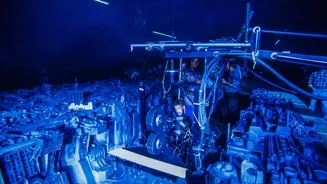
The dramatic climax of 'Casino Royale' (2006) sees a Venetian palazzo spectacularly collapse into the Grand Canal. While no historic Venetian buildings were harmed in the making of the film, the surrounding location is very real. The scene was staged on the Grand Canal near the Rialto Bridge. The collapsing building itself was a large-scale model and set constructed at Pinewood Studios in the UK, which was then digitally inserted into the Venice location footage. The surrounding buildings seen in the sequence are real palazzos in the Cannaregio district, which you can view from a vaporetto or the opposite bank today.
The Monastery on the Mountaintop in 'For Your Eyes Only'
In 'For Your Eyes Only' (1981), Roger Moore's Bond must scale a sheer cliff to reach the villain's seemingly impenetrable stronghold. This fortress was the Holy Trinity Monastery, one of the real Meteora monasteries in Greece. Perched atop a dramatic sandstone pillar, the location was perfect for the film's tense finale. While the interior scenes were built on a set, the breathtaking exterior shots, including parts of the climbing sequence, were filmed on-site. The movie brought global fame to the Meteora region, which was then a little-known destination, and it became a UNESCO World Heritage site a few years after the film's release.
The Day of the Dead Parade in 'Spectre'
The explosive opening sequence of 'Spectre' (2015) shows Daniel Craig's Bond navigating a massive and elaborate Day of the Dead parade in Mexico City's Zócalo, or main square. Interestingly, no such large-scale parade had ever been a part of the city's traditional Day of the Dead celebrations. The event was entirely invented for the film. However, the on-screen spectacle was so captivating that, in a case of life imitating art, city officials were inspired to create a real annual Day of the Dead parade in the years following the film's release, even incorporating props and costumes from the movie.