








The Eyes on the Sky
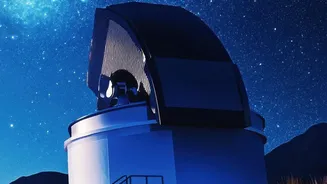
The first line of defence in protecting Earth from asteroid impacts is a fleet of robotic telescopes that automatically scan the heavens. Projects like the Asteroid Terrestrial-impact Last Alert System (ATLAS), with telescopes in Hawaii, Chile, and South
Africa, are designed to survey the entire night sky every 24 hours. These aren't necessarily the largest telescopes, but they are fast and wide-seeing, built to spot moving objects against the fixed backdrop of stars. They work by taking a series of four images of the same patch of sky over a short period. Computers then analyze these images, searching for faint dots of light that have moved. This rapid, repetitive scanning is crucial for finding smaller asteroids that are only visible when they get very close to Earth, sometimes just days or weeks before a potential impact.
A Worldwide Web of Data
No single observatory can watch the entire sky all the time. The Earth’s rotation, weather, and daylight mean that collaboration is essential. This is where the network aspect becomes critical. When a survey like ATLAS or the Catalina Sky Survey in Arizona gets a potential hit, the data doesn't stay local. It is sent to a central global clearinghouse: the Minor Planet Center (MPC). Operating under the International Astronomical Union, the MPC receives observations from astronomers—both professional and amateur—all over the world. It verifies the data, calculates a preliminary orbit for the newfound object, and posts it on a publicly accessible page called the Near-Earth Object Confirmation Page (NEOCP). This immediately alerts other observatories, who can then train their own telescopes on the object to gather more data.
From Detection to Alert
Once an object is posted on the NEOCP, a global race begins to refine its path. More observations from different locations allow scientists to calculate a much more precise orbit. This helps determine if the object is a Near-Earth Object (NEO)—an asteroid or comet whose path brings it within about 30 million miles of Earth's orbit. If the orbit is confirmed to be potentially hazardous, organizations like NASA's Planetary Defense Coordination Office (PDCO) and the international IAWN (International Asteroid Warning Network) take over. The PDCO is responsible for tracking and characterizing these objects, and if an object has a credible chance of hitting Earth, it issues warnings to government bodies. The IAWN, a UN-endorsed collaboration, serves as a global hub for communicating threat information to governments worldwide, ensuring a coordinated international response is possible.
The 'Short Notice' Challenge
Even with this sophisticated system, some asteroids are only found on very short notice. The ATLAS system, for instance, is specifically optimized to provide a few weeks' warning for a county-killer-sized asteroid (around 120-150 meters) and about a week's warning for a city-killer (around 45-50 meters). There are several reasons for this. Smaller asteroids are inherently faint and can only be seen when they are very close. Another major challenge is an asteroid approaching from the direction of the Sun. Ground-based telescopes are blinded by the Sun's glare, making this a significant blind spot. To counter this, space-based telescopes like NASA's upcoming NEO Surveyor will use infrared to detect asteroids' heat signatures, allowing them to spot objects even when they approach from the sunlit side. While there is no known asteroid larger than 140 meters that has a significant chance of impacting Earth in the next 100 years, the global network continues its watch, constantly improving its ability to provide as much warning as possible.