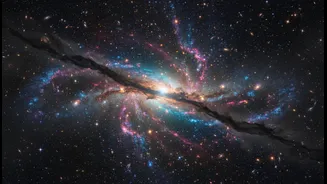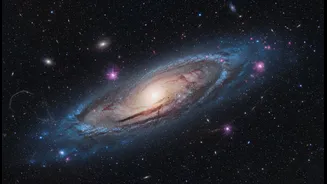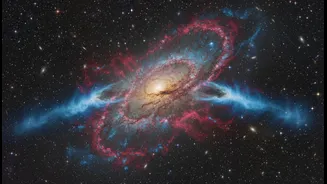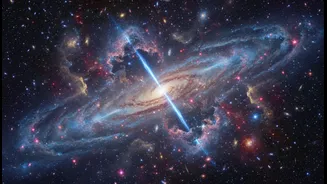





A Galaxy Shaped by Collision
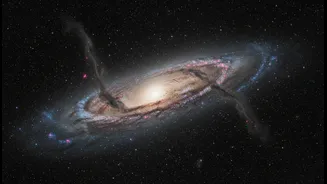
Located about 11 to 12 million light-years away, Centaurus A is not our quiet galactic neighbour. It's what astronomers call an active galaxy, and a peculiar one at that. Visually, its most striking feature is a massive, dark lane of dust that slashes
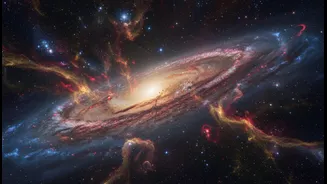
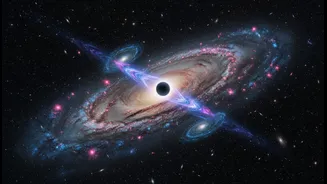
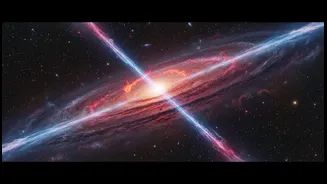
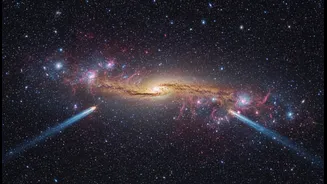
across its bright, elliptical core. This isn't just cosmic decoration; it's the mangled remains of a smaller spiral galaxy that collided with and is being consumed by the larger elliptical one. This galactic merger, which began roughly 2 billion years ago, has turned Centaurus A into a frenetic starburst factory, with intense pockets of new star formation glowing within the dusty debris. At its heart lies a supermassive black hole, 55 million times the mass of our sun, actively feeding on the infalling gas and dust. This cosmic engine spews out enormous jets of energy, making Centaurus A one of the brightest and largest radio sources in our night sky.
A New Landmark in Technology
For years, that thick shroud of dust has hidden the galaxy's core from view. Telescopes like Hubble, which see primarily in visible light, could only hint at what lay beneath. Now, the James Webb Space Telescope (JWST) has changed everything. Released to celebrate the telescope's fourth anniversary of science operations, the new images leverage Webb’s powerful infrared vision to pierce through the dust. The result is the most detailed view of Centaurus A ever captured. Where previous infrared telescopes like Spitzer saw a hazy glow, Webb resolves the scene into millions of individual stars. This technological leap, a testament to years of international collaboration and engineering, allows astronomers to perform galactic archaeology—distinguishing between generations of stars to reconstruct the galaxy's turbulent history.
What the Image Reveals
The composite image, combining data from Webb's Near-Infrared (NIRCam) and Mid-Infrared (MIRI) instruments, is breathtakingly complex. The dust lane is transformed from a dark slash into a glowing, golden-orange parallelogram rich with texture, knots, and intricate filaments. Above the core, a mysterious, delicate S-shaped structure made of warm dust is now visible, its origins still a puzzle for scientists. The entire galaxy, which once appeared smooth, is now revealed to have a finely speckled texture, each point of light a distinct star. Webb's instruments can also analyze the light to map how gas is moving, showing warm hydrogen rotating near the black hole while other gases are violently pushed outward by its energy jets. These details provide unprecedented clues about how supermassive black holes interact with and shape the galaxies they inhabit.
A Laboratory for the Cosmos
Because Centaurus A is so close and so active, it serves as a perfect natural laboratory for studying the most fundamental processes that shape our universe. Galactic collisions, the growth of supermassive black holes, and the life cycles of stars are all happening right there, in stunning detail. Every new piece of information gathered from these images helps astronomers refine their models of how all galaxies, including our own Milky Way, evolve over billions of years. While the Event Horizon Telescope has previously given us a hyper-focused look at the jet launching from the black hole's edge, Webb's new image provides the wider context, showing the impact of that engine on the entire galactic ecosystem. It’s a complete story in a single frame: a story of creation, destruction, and cosmic recycling.