


The 2026 Path of Totality
The upcoming total solar eclipse will trace a path across the Northern Hemisphere. The spectacle begins over northern Russia, then sweeps south across the Arctic, Greenland, and western Iceland, before reaching northern Spain in the evening. For those
in cities like Reykjavik, Iceland, and Burgos or Zaragoza in Spain, the Sun will be completely obscured by the Moon. A much wider area, including the rest of Europe, northwestern Africa, and parts of eastern North America, will witness a partial eclipse, where the Moon only covers a portion of the Sun.
The Life-Changing Magic of Totality
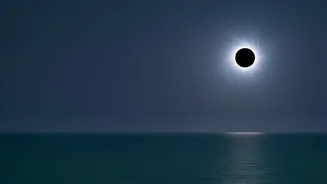
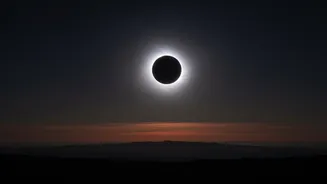
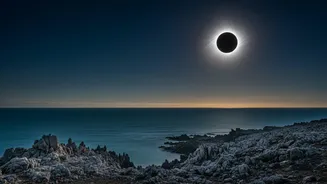
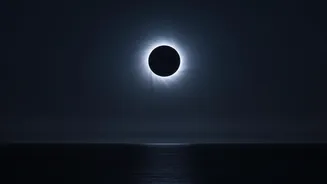
So, what's the big deal about being in the path of totality? It's the difference between watching a movie trailer and being in the movie itself. As the Moon fully blocks the Sun (an event called second contact), the world changes. Daylight vanishes into a deep, eerie twilight, causing temperatures to drop. The real prize, however, is the view: the Sun's ethereal outer atmosphere, the corona, becomes visible. This pearly white crown of light, normally invisible, streams into the darkened sky. Just before and after totality, you might see the 'diamond ring' effect or 'Baily's beads,' where the last and first rays of sunlight peek through lunar valleys. It is a multi-sensory experience that many viewers describe as deeply moving.
A Partial Eclipse: An Entirely Different Event
For those outside the path of totality, the experience is interesting but fundamentally different. During a partial eclipse, the Moon takes a 'bite' out of the Sun. Depending on your location, this bite can be large or small, but at no point does the Sun completely disappear. The sky may dim, similar to a cloud passing over, but it does not get dark. You won't see the corona, the diamond ring, or experience the sudden twilight that makes totality so profound. While still a fascinating celestial event to witness safely, it doesn't have the awe-inspiring, world-altering feel of a total eclipse. You can notice interesting effects, like tiny crescent-shaped shadows being cast by leaves on a tree.
Why 99% Obscured Is Not Totality
It’s a common misconception that a 99% partial eclipse is almost as good as a total one. This couldn't be further from the truth. The Sun's visible surface, the photosphere, is so intensely bright that even a 1% sliver is powerful enough to keep the sky lit and completely hide the delicate corona. The corona is about as bright as a full moon, while the photosphere is thousands of times brighter. This is why the sky only truly darkens when the photosphere is 100% covered. Experienced eclipse chasers often say there's no such thing as a 99% total eclipse; you are either in the Moon's full shadow (the umbra) and see totality, or you are in its partial shadow (the penumbra) and see a partial eclipse.
How to Watch Any Eclipse Safely
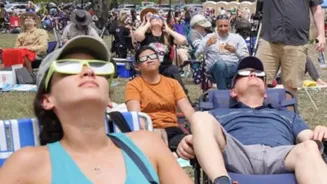
Whether partial or total, safety is paramount. It is never safe to look directly at the Sun without specialized eye protection, except during the brief moments of totality. Regular sunglasses, no matter how dark, are not sufficient. You must use certified solar viewing glasses (often called 'eclipse glasses') that comply with the ISO 12312-2 international standard, or a handheld solar viewer. These filters are thousands of times darker than sunglasses. Always inspect your filter for scratches or damage before use. An alternative method is projection, where you can use a pinhole projector or even a pair of binoculars (projecting the image, not looking through them) to cast a live image of the Sun onto a surface. During the brief moments of full totality, it is safe to remove your filters and look with the naked eye, but as soon as the Sun begins to reappear, you must put them back on immediately.