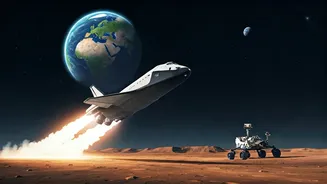










Beyond the First Flight: A Station in the Stars
The Gaganyaan programme is more than a single mission to demonstrate human spaceflight capability; it is the foundational step for a sustained Indian presence in space. [11] The ultimate goal is not just to reach low-Earth orbit, but to stay there. This
ambition is crystallised in the plan for the Bharatiya Antariksha Station (BAS), India's own modular space station. [2, 3] The first module for the BAS is targeted for launch by 2028, with the station expected to be fully operational by 2035. [3, 4, 7] This orbiting platform will allow Indian astronauts, or 'Gaganyatris', to conduct long-duration missions of three to six months, transforming the nation from a visitor in space to a resident. [3, 6] This makes Gaganyaan's initial flights crucial, as they will test the very technologies—from life support to rendezvous and docking—essential for building and operating this future home in the cosmos. [12, 13]
A Crucible for 'Made in India' Technology
Sending humans to space is one of the most complex technological challenges, forcing a nation to develop a wide range of cutting-edge capabilities. [9] The Gaganyaan programme is a powerful engine for Aatmanirbhar Bharat (self-reliant India), driving indigenous development in critical areas. This includes the human-rated LVM3 rocket, a reliable launch vehicle modified for crewed flight, a life support system to provide an Earth-like environment in space, and robust crew escape systems. [12] ISRO, along with private industry and academic institutions, is developing everything from space-grade food and astronaut health monitoring systems to advanced avionics. [5, 12] These technological spinoffs have applications far beyond space, with the potential to fuel innovation in healthcare, materials science, and water purification back on Earth, boosting India's overall industrial and economic capabilities. [10, 19]
The Ultimate Laboratory: Science in Microgravity
A sustained human spaceflight program unlocks a unique laboratory: the microgravity environment of orbit. The Bharatiya Antariksh Station will serve as a floating lab where scientists can conduct experiments impossible on Earth. [7] Research in microgravity offers profound insights into materials science, fluid physics, and combustion. More importantly, it is a revolutionary platform for biomedical and pharmaceutical research. Studying the effects of space on the human body can lead to breakthroughs in understanding aging, disease progression, and developing new medicines. [7, 10] Gaganyaan's follow-up missions will transition from technology demonstrators to scientific expeditions, allowing India to conduct cutting-edge research aligned with national priorities. [7, 11]
India’s Place in the Cosmos
Successfully launching its own astronauts will place India in an elite club of nations with independent human spaceflight capability, currently comprising only the US, Russia, and China. [10] This achievement carries immense geopolitical weight, enhancing India's global standing and projecting its image as a major technological power. [9, 13] It strengthens India's role in international space diplomacy and opens doors for deeper collaborations with agencies like NASA and Roscosmos. [9, 18] As space becomes an increasingly competitive and collaborative domain, the ability to send humans to orbit is a critical strategic asset. It ensures India has a seat at the table in shaping the future of space exploration, from missions to the Moon and Mars to the governance of celestial bodies. [11, 13]
Inspiring a Billion Dreams
Perhaps one of the most significant, though intangible, impacts of Gaganyaan is its power to inspire. [5] Much like landmark missions in other countries created a "Sputnik moment," seeing Indian astronauts in space will capture the national imagination. It is expected to encourage a generation of students to pursue careers in science, technology, engineering, and mathematics (STEM), creating a pipeline of talent that will drive future innovation. [5, 11] The mission is also a catalyst for economic growth, projected to create thousands of jobs and foster a robust partnership between academia and industry. [5] India’s space economy is currently valued at $8 billion and is projected to grow to over $40 billion in the next decade, with Gaganyaan serving as a major driver of this expansion. [18, 21]