

A Landmark Mission to the 'Dark Side'
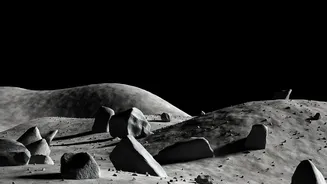
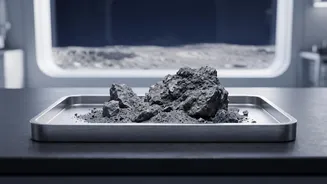
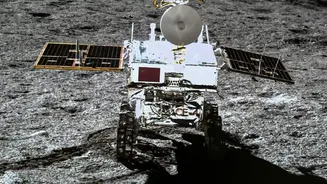
The story begins with a groundbreaking achievement in space exploration. China's Chang'e-6 mission successfully landed in the South Pole-Aitken (SPA) basin, the largest, deepest, and oldest impact crater on the Moon, and returned with the first-ever samples
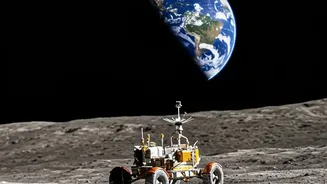
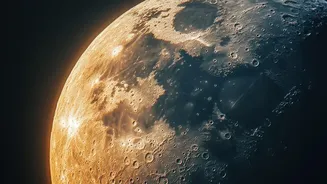
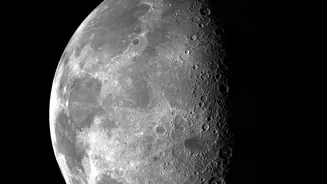
from this unexplored territory. For decades, our understanding of the Moon's geology was based entirely on samples from the nearside, collected by the Apollo, Luna, and more recent Chang'e-5 missions. This created a biased picture, akin to trying to understand Earth by only studying one continent. The farside, permanently hidden from Earth, is strikingly different, with a thicker crust and far fewer of the dark volcanic plains, or 'maria', that form the 'Man in the Moon' on the nearside. Scientists have long hypothesized about the reasons for this asymmetry, but without physical evidence, their ideas remained theories. The Chang'e-6 samples, weighing just under two kilograms, represent the missing puzzle pieces needed to build a complete history of our nearest celestial neighbour.
Clues Locked in Ancient Rocks
Upon analysis, these precious grains of dust and rock began telling a dramatic story. Scientists discovered that the samples contained basalt—a type of hardened lava—proving that the farside also had active volcanoes. By analysing the chemical makeup and isotopes within the rocks, researchers dated this volcanic activity to around 2.8 billion years ago. This finding is crucial because it confirms that the Moon's interior was hot enough to produce flowing magma on both sides, not just the one facing Earth. The composition of these farside basalts showed they originated from a mantle source that was depleted in certain elements, unlike many nearside rocks that are rich in a cocktail of elements known as KREEP (potassium, rare earth elements, and phosphorus). This distinction provides a powerful clue, suggesting that while the deep mantle of the Moon might be relatively uniform, something happened closer to the surface to create the dramatic differences we see today.
Reimagining a Molten Moon
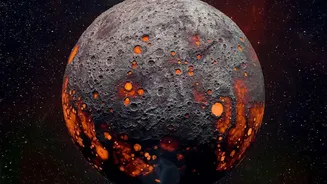
The evidence points toward a grand theory known as the 'lunar magma ocean'. In its infancy, about 4.5 billion years ago, the Moon was a global ball of molten rock. As this ocean cooled, denser minerals sank to form the mantle, while lighter minerals floated to create the crust. However, the Chang'e-6 samples support a new twist in this story. Analysis suggests that after the Moon became tidally locked with Earth, our planet's gravitational pull caused uneven heating. This triggered massive, slow-moving convection currents within the remaining molten rock deep inside the Moon. These currents effectively pushed crust-forming materials toward the farside, making its crust thicker, while concentrating the last dregs of the magma ocean—the heat-producing KREEP elements—on the nearside. This concentration of radioactive elements on the nearside kept it hotter for longer, fuelling the vast volcanic lava flows that created the dark plains we see from our backyards. The farside, having less of this thermal fuel, cooled faster and experienced less volcanism.
Why This Discovery Matters for Us
Reconstructing the Moon's ancient past is more than just an academic exercise. Understanding the Moon's formation and evolution provides a direct window into the early history of our own planet. Earth's geological record from that era has been erased by plate tectonics and erosion, but the Moon, geologically quiet for billions of years, preserves that history. This new, more complex picture of lunar volcanism helps scientists refine models of how rocky planets form and cool. Furthermore, as nations like India with its Chandrayaan program and the US with its Artemis missions plan future lunar expeditions, this knowledge is invaluable. Pinpointing the location of different rock types and understanding the mantle's composition is key to identifying resources for potential future bases, from water ice to minerals. These farside samples have not just solved an old mystery; they have provided a new roadmap for the future of lunar exploration.