



The Tireless Robotic Pioneers
Our robotic exploration of the Martian surface began in earnest with a duo of twin rovers, Spirit and Opportunity, which landed in 2004. Designed for a mere 90-day mission, these solar-powered geologists shattered all expectations. Spirit operated for over six
years, while Opportunity roamed for nearly 15, eventually covering over 45 kilometres. Their mission was to 'follow the water', and they succeeded spectacularly, finding definitive proof that Mars once had liquid water on its surface. Opportunity discovered rocks that appeared to have formed on the shoreline of an ancient, salty sea. These golf-cart-sized explorers proved that robots could not only survive the harsh Martian environment but thrive, conducting valuable science for years on end and paving the way for more ambitious missions to come.
Curiosity: A Mobile Chemistry Lab
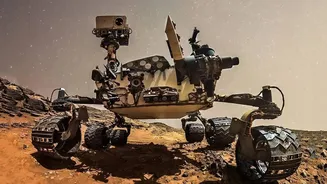
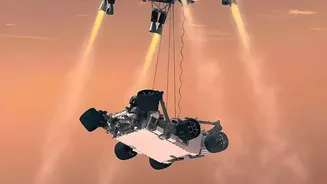
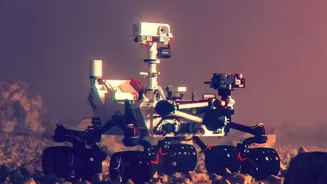
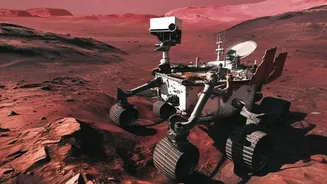
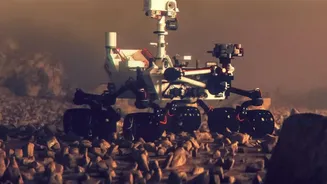
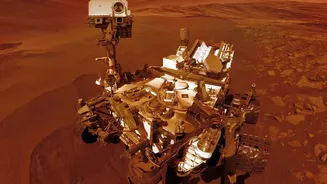
If Spirit and Opportunity were geologists, the Curiosity rover, which landed in 2012, is a full-blown mobile chemistry lab. The size of a small car, Curiosity's main goal was to determine if Mars ever had the right environmental conditions to support microbial life. Landing in Gale Crater, a site believed to be a former lakebed, the rover's advanced instruments got to work. It drilled into rocks and analysed the powder, soon discovering the key chemical building blocks of life, including sulfur, nitrogen, oxygen, and carbon. The findings confirmed that billions of years ago, Mars was indeed habitable. Curiosity's longevity, powered by a radioisotope thermoelectric generator instead of solar panels, has allowed it to study the Martian climate and geology for over a decade, far surpassing its initial two-year mission.
Perseverance and the Hunt for Past Life
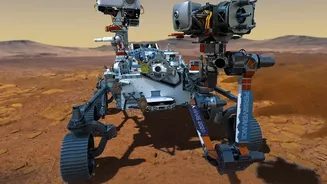
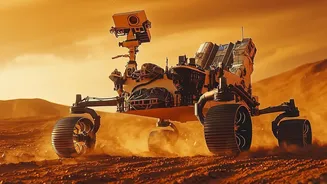
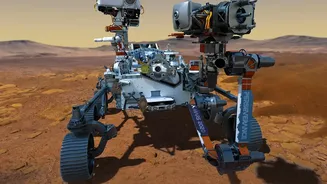
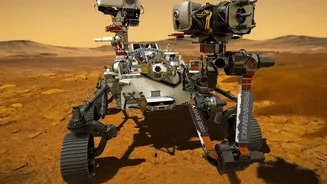
The latest robotic explorer, Perseverance, landed in 2021 with the most direct objective yet: to seek signs of ancient life. Exploring Jezero Crater, the site of a 3.5-billion-year-old river delta, Perseverance is equipped with a sophisticated suite of tools to analyse rock composition for biosignatures. But its most crucial task is collecting and caching rock and soil samples. These samples, stored in sealed tubes, are intended to be picked up by a future mission and returned to Earth for intensive study in advanced laboratories. Perseverance has also tested technologies for future human explorers, successfully generating oxygen from the thin Martian atmosphere using its MOXIE instrument. It even deployed Ingenuity, a small helicopter that proved powered flight is possible on another world.
The Overwhelming Case for Robots
The success of these rovers highlights the powerful arguments for robotic exploration. The most compelling factor is cost. The Perseverance rover mission cost under $3 billion, whereas estimates for a single crewed mission to Mars range from over $100 billion to as high as $600 billion. Robots don't need life support, food, water, or a return ticket, all of which add immense weight, complexity, and expense to a human mission. They are also immune to the dangers of space radiation and the physiological effects of microgravity. A robot can operate for more than a decade, collecting data patiently and precisely, in environments that would be lethal to an unprotected human. They are our expendable, tireless, and hyper-capable scientific scouts.
But What About the Human Touch?
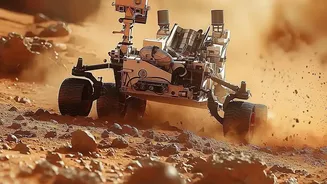
Despite the rovers' triumphs, there remains a strong case for sending people. The primary human advantage is adaptability and speed. A human geologist could explore a vast area, identify interesting rocks, and collect samples in a single day—a task that might take a rover months or even years to complete. Rovers move incredibly slowly, with Curiosity's top speed being just 0.14 kilometres per hour, and every action must be carefully programmed and commanded from Earth, with a time delay of up to 20 minutes each way. Humans can react to unexpected findings in real-time, apply intuition, and solve complex mechanical problems on the spot. Some scientists argue that only a human on the ground, cracking open countless rocks, will ever be able to definitively find the subtle fossilised evidence of past microbial life.