




A Mission to a Metal World
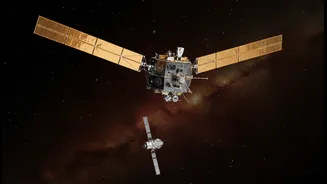
NASA's Psyche mission is one of the most intriguing journeys of our time. Launched in October 2023, the spacecraft is headed towards a metal-rich asteroid also named Psyche, located in the main asteroid belt between Mars and Jupiter. Scientists believe
this asteroid could be the exposed nickel-iron core of an ancient, failed planet, a protoplanet that was shattered by collisions billions of years ago. By studying it up close, we could unlock secrets about how terrestrial planets like Earth formed. The spacecraft is equipped with a suite of advanced instruments, including multispectral imagers, to map the asteroid's surface and determine its composition. But before it reaches its final destination in 2029, every piece of equipment must be tested and proven ready for the main event.
A Necessary Pit Stop at Mars
To get to the asteroid belt efficiently, the Psyche spacecraft needed to perform a critical maneuver known as a gravity-assist flyby. On May 15, 2026, it swung incredibly close to Mars, passing just over 4,500 kilometers above its surface. This cosmic slingshot used the Red Planet's gravity to increase Psyche's speed and adjust its trajectory, bending its path perfectly toward its distant target. Such maneuvers are a staple of interplanetary travel, saving enormous amounts of fuel and time. But the Psyche team saw another valuable opportunity in this flyby: a chance to give their spacecraft's science instruments a full dress rehearsal using a well-known subject.
An Old Hand Meets a Newcomer
The perfect partner for this test was already waiting at Mars. The European Space Agency's (ESA) Mars Express has been orbiting the Red Planet since 2003, making it a seasoned veteran of planetary observation. Its cameras and sensors are well-understood, and its data has been meticulously calibrated over two decades. In a remarkable feat of inter-agency coordination, teams at NASA and ESA worked together for weeks, exchanging trajectory data and timelines. The plan was for the newcomer, Psyche, and the old hand, Mars Express, to photograph the exact same region of the Martian surface at nearly the same time.
A Coordinated Interplanetary Photoshoot
As Psyche flew past Mars, both it and Mars Express pointed their cameras towards a region called Noachis Terra, one of the oldest and most cratered landscapes on the planet. Though they took their shots about an hour and 50 minutes apart, the coordination was key. Mars Express captured its image from an altitude of about 6,000 km, while Psyche, receding from its closest approach, snapped its picture from roughly 41,000 km away. The result was two distinct views of the same terrain. This wasn't just for a cosmic photo album; it was a crucial calibration exercise. By comparing the brightness, color, and details in the images from Psyche's new cameras to the reliable data from Mars Express, scientists can fine-tune their understanding of Psyche's instruments.
Ensuring a Clear View of an Asteroid
This calibration exercise is invaluable. It helps scientists identify and correct for any subtle differences in how Psyche's imagers perceive light and color before the spacecraft begins its primary mission. It’s like tuning an orchestra before a concert. By using the well-documented surface of Mars as a reference point, the team can ensure that when Psyche finally arrives at its mysterious metal asteroid, the data it sends back will be as accurate and reliable as possible. This 'in-flight' check-up minimizes uncertainty and maximizes the scientific return of the entire mission, ensuring our first-ever view of a planetary core is crystal clear. The successful collaboration also provided valuable navigation data, further confirming Psyche is on the right path.