



What Exactly Is an Interstellar Visitor?
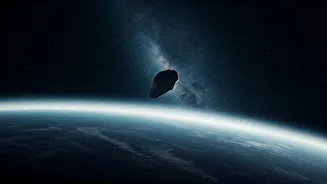
In simple terms, an interstellar object is a comet, asteroid, or other celestial body that isn't gravitationally bound to our Sun. While our solar system is full of rocks and ice that have been orbiting the Sun for 4.6 billion years, these interlopers
come from the vast space between the stars. They are objects that once belonged to another star system but were somehow ejected, perhaps by the gravitational pull of a giant planet, and sent adrift through the galaxy. After traveling for millions or even billions of years, their path happens to cross ours, giving scientists a brief window to study a piece of another world.
Meet the Famous Few
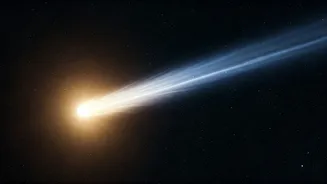
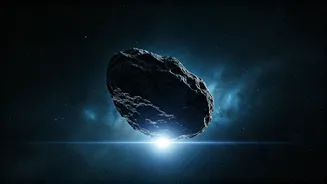
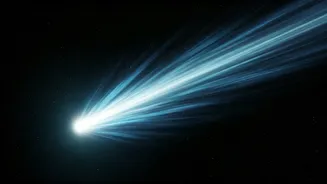
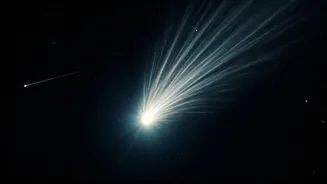
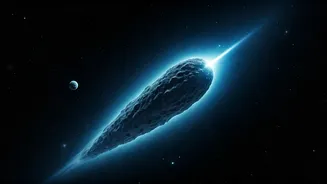
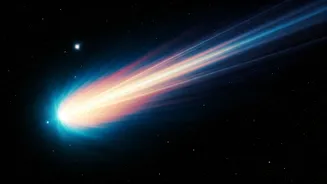
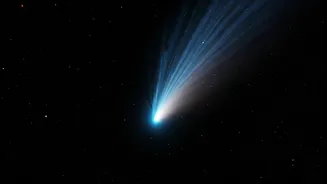
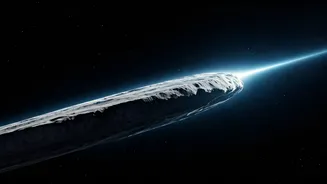
For a long time, these visitors were purely theoretical. That changed in 2017 with the discovery of 1I/‘Oumuamua, a name that means "scout" in Hawaiian. ‘Oumuamua was baffling; it had a strange, highly elongated shape and accelerated away from the Sun faster than gravity alone could explain, yet it showed no visible cometary tail. This mystery made it famous. Two years later, 2I/Borisov arrived. Discovered by an amateur astronomer, Borisov was more familiar—it looked and acted much like the comets from our own solar system, complete with a tail of gas and dust. However, it contained an unusually high amount of carbon monoxide. As of mid-2025, a third visitor, 3I/ATLAS, was identified, offering yet another data point in our growing understanding of these travelers.
Unpacking Their Cosmic Luggage
So, why the excitement? Because these objects are physical samples from other solar systems—something we can't get any other way, short of sending a probe across light-years of space. Studying their composition is like unpacking their luggage. By analyzing the light reflected off them and the gases they release, scientists can determine what they're made of. Borisov’s familiar cometary nature suggested that the building blocks for planets might be quite similar in other star systems. The peculiarities of ‘Oumuamua, meanwhile, forced scientists to consider new theories about what kinds of objects can form around other stars. Each one provides crucial clues about the chemistry and conditions of distant planetary systems.
Why They're Our Cosmic Exchange Students
This is where the "exchange student" analogy really clicks. These objects arrive from their "home" star system and, for a short while, share information with us that is completely new. They give us a glimpse into the diversity of the galaxy. Does every solar system look like ours? Are the ingredients for life common? Interstellar objects help us begin to answer these profound questions. The fact that 2I/Borisov was so similar to our own comets suggests that the processes of planet formation might be quite universal. By comparing these visitors to our native asteroids and comets, we learn as much about ourselves as we do about them.
The Hunt for the Next Arrival
Detecting these objects is incredibly difficult. They are small, faint, and moving extremely fast, often noticed only as they are already on their way out of our solar system. Until recently, we were lucky to find any at all. But a new era of astronomy is dawning. Observatories like the Vera C. Rubin Observatory, which began its survey in 2026, are designed to scan the entire sky repeatedly with unprecedented sensitivity. Instead of spotting one visitor every few years, astronomers expect to find dozens. This will transform the field from the study of a few oddities into a statistical analysis of a whole population of objects from across the Milky Way, revolutionizing our understanding of how planetary systems form and evolve.