






Beyond the Textbook
For generations, engineering education has relied on a combination of theoretical lectures, dense textbooks, and limited, often expensive, hands-on lab time. For complex fields like aerospace, this presents a significant bottleneck. A physical wind tunnel
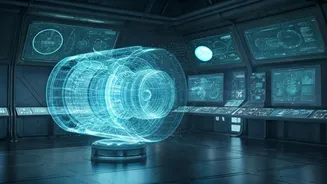
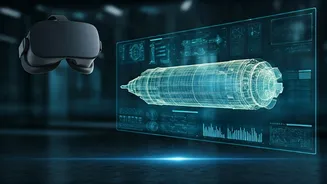
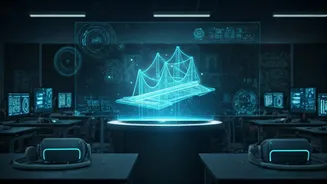
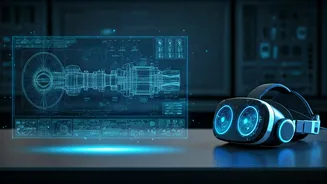
or a jet engine assembly is a multi-crore investment, accessible to only a few. Now, a technological revolution is underway, aiming to dismantle these barriers. By integrating Virtual Reality (VR) with interactive Artificial Intelligence (AI), educators are creating digital twins of advanced laboratories. These VR classrooms are not just about watching 3D videos; they are fully immersive, interactive spaces where students can conduct experiments, manipulate complex machinery, and learn from mistakes in a safe, repeatable, and cost-effective environment.
Inside the Virtual Lab
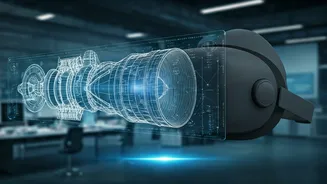
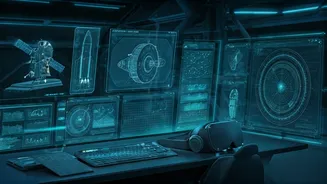
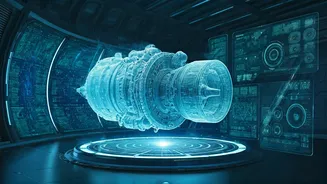
So, what does a VR aerospace lab session look like? A student puts on a VR headset and is immediately transported. They might find themselves standing in front of a to-scale model of a satellite, a fighter jet cockpit, or the intricate turbine of an aircraft engine. Using haptic gloves, they can 'pick up' virtual tools, disassemble components, and see how different parts interact. This is where the AI comes in. The AI acts as an intelligent tutor, guiding the student through a complex procedure, highlighting the next step, or providing real-time feedback on their work. It can also simulate scenarios. For instance, the AI could introduce a 'fault' into the virtual engine and challenge the student to diagnose and fix it, tracking their problem-solving process. This adaptive learning is a game-changer, allowing each student to learn at their own pace and master concepts through practice, not just memorisation.
Solving Real-World Problems
The benefits of this approach extend far beyond just being a 'cool' new technology. The most obvious advantage is cost. A single software platform can provide thousands of students with access to virtual equipment that would be financially impossible to procure physically. Secondly, safety is paramount in aerospace. VR allows trainees to practice high-risk maintenance procedures—like handling volatile fuel lines or working on pressurised systems—without any physical danger. Mistakes in the virtual world are learning opportunities, not catastrophic failures. Furthermore, these platforms democratise access. A student in a tier-2 city college can have the same high-quality lab experience as someone at a premier global institution, levelling the playing field for talent across the country.
A New Trajectory for India
For India, with its rapidly growing aerospace and defence sectors and its ambition to become a global manufacturing hub, this technology is particularly relevant. The country has a massive pool of engineering talent, but there's often a gap between academic knowledge and industry-ready skills. Traditional education struggles to keep pace with the rapid evolution of aerospace technology. VR/AI labs can bridge this gap. They can train students on the very same digital models and systems used by companies like ISRO, HAL, or private sector players. This ensures that graduates are not just theoretically sound but are also familiar with the practical workflows and digital tools of the modern aerospace industry. It aligns perfectly with national initiatives like 'Skill India' by preparing a workforce for the high-tech jobs of the future.
The Challenges on the Horizon
Despite the immense potential, widespread adoption is not without its hurdles. The initial investment in high-quality VR headsets, powerful computing hardware, and sophisticated software development can be substantial for educational institutions. Creating accurate, pedagogically sound virtual content is also a complex, specialised task that requires collaboration between software developers, educators, and industry experts. There are also concerns about digital equity—ensuring that students without access to high-speed internet or the necessary hardware at home are not left behind in a blended learning model. Overcoming these challenges will require strategic investment, public-private partnerships, and a clear vision from policymakers and academic leaders.