

Spotting a Potential Candidate
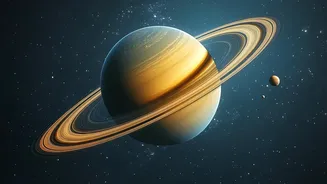
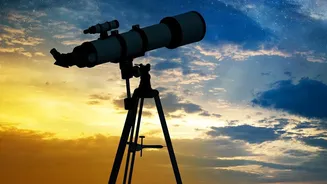
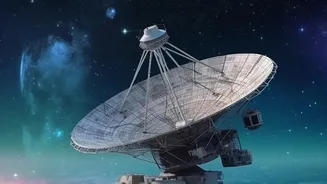
The journey to discovering a new moon begins with a faint dot of light. Astronomers use powerful ground-based telescopes, like the Canada-France-Hawaii Telescope or the Subaru Telescope in Hawaii, to take a series of deep-sky images of the area around
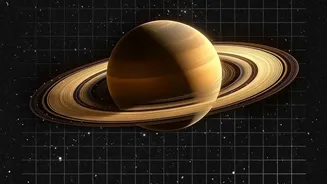
Saturn. The challenge is immense; these potential moons are often just a few kilometres across and incredibly dim, easily lost in the glare of the massive planet and its bright rings. By taking multiple pictures over several hours or days, astronomers can look for objects that move relative to the background stars. A technique called "shift and stack" is often used, where images are layered and aligned based on the predicted movement of a satellite, causing a faint object to become more prominent while the stars streak into lines. This process helps distinguish a potential moon from a distant star or a passing asteroid.
The Deciding Factor: Confirming the Orbit
Spotting a moving object is just the first step. The critical test to determine if it's a moon is to prove that it is gravitationally bound to Saturn. This means it must be in a stable orbit around the planet, not just flying by. To confirm this, astronomers need to track the object's position over a prolonged period—sometimes years. These observations allow them to calculate a precise orbital path. The data is then sent to organisations like the International Astronomical Union's (IAU) Minor Planet Center. The center's experts perform complex calculations to verify that a planet-centric orbit is the most likely trajectory, rather than an orbit around the Sun (heliocentric). This painstaking work confirms that the object is a natural satellite, a true moon, and not a captured asteroid that might one day escape Saturn's pull.
What Officially Counts as a Moon?
You might be surprised to learn there is no strict, formal definition for a moon from the IAU, unlike the detailed criteria for a planet. Generally, a moon is considered any natural celestial body that orbits a planet, dwarf planet, or even an asteroid. There is no official size limit that separates a "moon" from a large chunk of rock. However, in practice, a distinction is often made. Tiny objects within Saturn's rings, sometimes only a few hundred metres across, are often called "moonlets," especially if they are too small to be imaged directly and are only detected by their gravitational pull on ring particles. The objects typically designated as moons are usually solid bodies several kilometres in diameter that have been tracked and confirmed as having a stable orbit.
The Tools of Discovery
Discovering Saturn's moons has always been tied to technological advancement. Early discoveries like Titan in 1655 were made with simple refracting telescopes. Today, astronomers rely on a combination of powerful ground-based observatories and dedicated space missions. The NASA/ESA Cassini-Huygens mission, which orbited Saturn from 2004 to 2017, was revolutionary. Its close proximity provided an unprecedented view, allowing it to discover several small, inner moons like Methone and Pallene, and even capture images of a possible moon, nicknamed "Peggy," forming or disintegrating within the rings. Cassini's instruments also studied the composition of these moons, revealing that many are coated in material from Saturn's rings and ice from the larger moon Enceladus.
From a Number to a Name
Once a moon's orbit is confirmed, it receives a provisional designation from the IAU, such as S/2019 S 1, which indicates it's a satellite discovered around Saturn in 2019. After further observation solidifies its status, it becomes eligible for a permanent name. For Saturn's moons, the IAU follows a specific convention, drawing names from Gallic, Norse, and Inuit mythology. This final step transforms the object from a set of data points into a recognised member of the Saturnian system, a world with a name and a place in our celestial maps. This process ensures that each discovery is catalogued, confirmed, and given a unique identity within the grand family of our solar system.