


Why It’s Not Just Simple Math
Halving a recipe seems straightforward, but baking is a science. When you reduce ingredients, you're changing the chemistry. A smaller volume of batter or dough behaves differently. For example, in a larger, half-filled pan, the mixture spreads out, becomes
thinner, and cooks much faster, often leading to dry or burnt edges. The rate of evaporation and heat transfer also changes. The original recipe's instructions are calibrated for a specific mass and depth of food. Simply halving the ingredients without considering the vessel and time ignores the physics of cooking and can lead to disappointing results.
Choosing the Right Pan Size
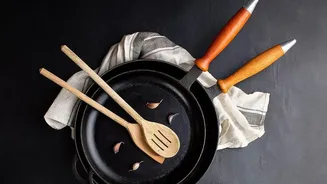
The most crucial step after adjusting your ingredients is selecting the correct pan. Using the original pan will create a thin layer that bakes too quickly. The goal is to maintain the same batter depth as the original recipe to ensure similar heat penetration and texture. The best way to find a substitute is to calculate the surface area or volume. For instance, a standard 9x13 inch pan has a surface area of 117 square inches. If you halve a recipe designed for this pan, you need a pan with roughly half that area, which is about 58 square inches. An 8x8 inch (64 square inches) or a 9-inch round pan (63.5 square inches) are excellent substitutes. A quick rule of thumb is that a 9x13 inch pan recipe can be halved into an 8-inch or 9-inch square or round pan.
Adjusting Your Cooking Time
With less food in the pan, it will naturally cook faster. However, the time doesn't simply get cut in half. A good starting point is to reduce the original baking time by about 25% to 33%. If a cake originally baked for 40 minutes, start checking it around the 30-minute mark. Some experts suggest checking as early as half the original time, just to be safe, because you can always bake something longer, but you can't un-bake it. Factors like the new pan's material (glass heats differently than metal) can also influence the time. The most reliable method is to ignore the clock in the final minutes and use your senses. Look for visual cues like golden-brown edges, check for springiness, and use a toothpick or cake tester to determine doneness.
Handling Tricky Ingredients
Some ingredients resist being neatly halved. The most notorious is the egg. How do you use half an egg? The solution is simple: crack a whole egg into a small bowl, whisk it until the yolk and white are completely combined, and then measure out half of the mixture. A large egg is roughly 4 tablespoons, so half would be 2 tablespoons. A kitchen scale provides even more accuracy. For other measurements, like 1/4 cup, it's helpful to know the conversions (1/4 cup is 4 tablespoons, so half is 2 tablespoons). It's a good idea to write down all your new measurements before you begin to avoid confusion in the middle of cooking.
When Not to Halve a Recipe
While most recipes are adaptable, some are more challenging. Recipes relying on yeast, for example, can be finicky when scaled down, as the fermentation process might not behave as expected in smaller quantities. Similarly, for very small recipes, a stand mixer might not be able to properly incorporate the ingredients, as there isn't enough volume for the paddle or hook to work effectively. In these cases, it might be better to make the full batch and freeze the leftovers. Many baked goods, soups, and sauces freeze beautifully, saving you from a potential recipe failure and giving you a ready-made meal for a future date.