



The Unique Challenge of a Water Workout
Exercising on an unstable surface like water provides a unique benefit that you can't replicate on solid ground. Both kayaking and stand-up paddleboarding force your body to constantly make small, subconscious adjustments to maintain balance. This process
engages your deep core stabiliser muscles—the foundation of a strong and resilient midsection. This continuous balancing act not only improves your core strength but also enhances proprioception, which is your body's awareness of its position in space. The result is better coordination, improved posture, and a core that's prepared for dynamic, real-world movements.
Paddleboarding: A Full-Body Balancing Act
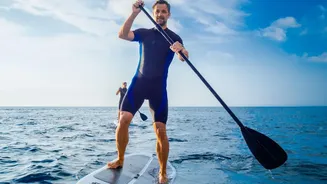
Stand-up paddleboarding delivers a true full-body workout, with the core at the centre of it all. To stay upright on the board, your core must remain constantly engaged, much like holding a standing plank. Your legs and glutes work tirelessly to provide a stable base, while your deeper core muscles, like the transverse abdominis, act as a natural corset to keep you steady. The act of paddling adds another layer, working the arms, shoulders, and back. However, the primary challenge in SUP is maintaining balance against the shifting water, which requires constant micro-adjustments from head to toe. This makes it an exceptional exercise for building functional stability and endurance across the entire body.
Kayaking: The Power of Rotational Strength
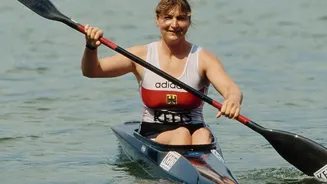
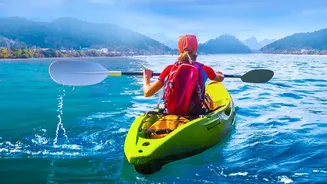
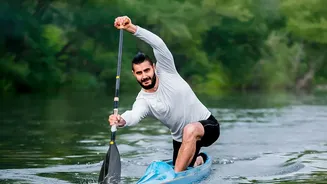
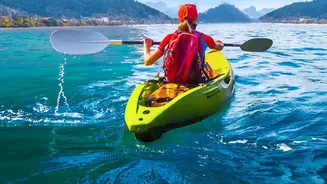
While kayaking might look like an upper-body-only activity, the real power comes from the core. A proper kayaking stroke is a rotational movement that originates from your midsection. As you pull the paddle through the water, you engage your obliques (the muscles on the sides of your abdomen) and lats (the large muscles in your back) to twist your torso. This powerful twisting motion is what propels the kayak forward efficiently. Your rectus abdominis (the 'six-pack' muscles) and lower back muscles also work to stabilise your spine from a seated position. This makes kayaking an incredible workout for developing rotational power and a strong, defined upper core and back.
Head-to-Head: Stability vs. Dynamic Strength
So, how do they stack up? Paddleboarding is fundamentally about whole-body stability. It challenges your core to work isometrically, meaning the muscles are tensed to hold a position rather than moving through a range of motion. Think of it as a workout that builds stability from the ground up. Kayaking, on the other hand, is about generating dynamic, rotational strength. From a stable seated base, your core's job is to twist and transfer power to the paddle. While both build core strength, SUP focuses on balance and endurance, engaging nearly every muscle. Kayaking hones in on powerful, repetitive core rotation, providing a more intense workout for the obliques, back, and shoulders.
Which Is Right for Your Fitness Goals?
The best choice truly depends on what you want to achieve. If your goal is a holistic, low-impact workout that improves balance, posture, and full-body toning, stand-up paddleboarding is an excellent option. It's like combining a plank, a squat, and an upper-body workout all in one. If you're more interested in building powerful rotational core strength, endurance, and significant upper-body definition, kayaking is the superior choice. It directly targets the muscles responsible for twisting movements, which is beneficial for many other sports and daily activities. Both are low-impact, making them gentle on the joints and suitable for various fitness levels.