




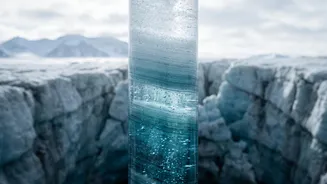
A Library of Frozen Time
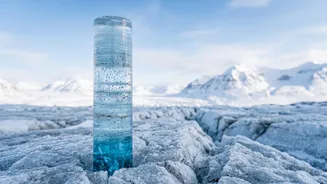
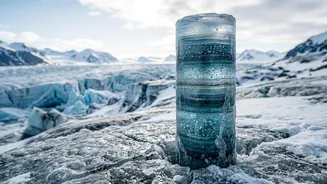
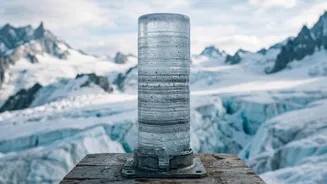
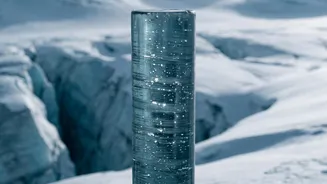
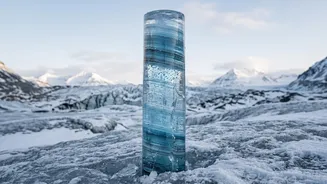
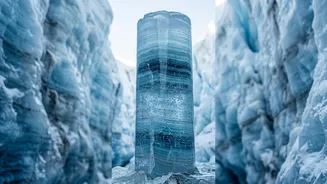
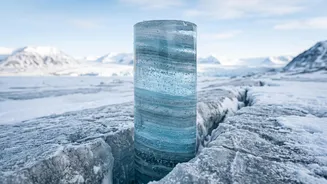
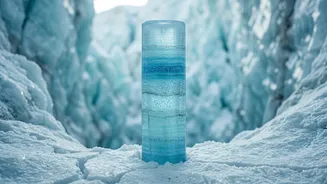
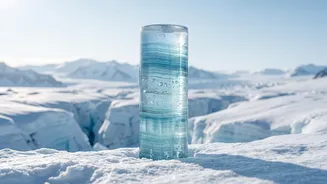
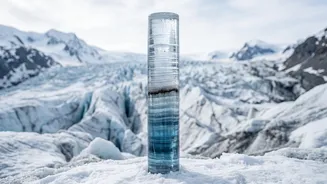
Ice cores are cylinders of ice drilled from the depths of ancient glaciers and ice sheets. Each year, new layers of snow fall, burying and compressing the layers from previous years. This process traps information about the environment at the time the snow fell.
In places like Antarctica, where the ice can be over three kilometers deep, these layers form an unbroken timeline stretching back hundreds of thousands of years, with the oldest ice at the bottom. Some records extend back 800,000 years, and recent projects are pushing that record to over 1.2 million years. By extracting these cores, scientists can read the story of Earth’s climate, year by year.
Trapped Bubbles of Ancient Air
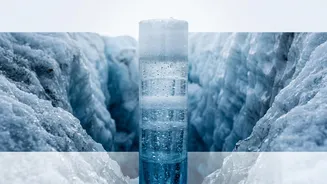
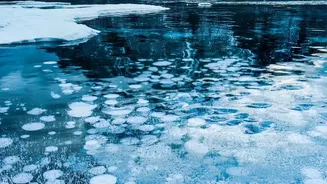
One of the most remarkable features of ice cores is the tiny bubbles of air trapped within the ice. These bubbles are not just empty pockets; they are perfectly preserved samples of Earth's past atmosphere. As snow is compressed into ice, the air between the snow crystals gets sealed off. Scientists can carefully extract this ancient air and measure the concentrations of crucial greenhouse gases like carbon dioxide (CO2) and methane. This provides a direct record of how the atmosphere's composition has changed over millennia, showing that CO2 levels have cycled between about 180 and 300 parts per million for at least 800,000 years, a range far below today's levels.
A Natural Thermometer
Beyond the air it holds, the ice itself is a powerful climate indicator. The water molecules (H2O) that make up the ice contain different forms, or isotopes, of oxygen. The most common is a lighter isotope, Oxygen-16, while a heavier version, Oxygen-18, is rarer. Scientists have found that the ratio between these two isotopes in the ice is directly related to the air temperature when the snow first fell. Colder temperatures mean less of the heavy Oxygen-18 makes it into the polar precipitation. By analyzing this ratio layer by layer, researchers can reconstruct a detailed history of regional and global temperature fluctuations.
More Than Just Ice and Air
Ice cores also capture a wide array of other particles from the atmosphere, each telling its own story. Layers of volcanic ash can pinpoint the dates of major eruptions, helping scientists synchronize records across the globe. Dust blown from continents can indicate past droughts and wind patterns, while trapped pollen reveals changes in vegetation. Even chemical traces from distant forest fires can be found locked in the ice. By examining these impurities, scientists can build a comprehensive picture of the Earth's environment at specific points in history, creating a richer, more detailed narrative of past events.
Putting the Pieces Together
Dating the ice is a critical and complex process. For more recent layers, scientists can simply count the annual bands, much like counting tree rings. For deeper, more compressed ice, they rely on mathematical models of ice flow and identify layers from known global events, like volcanic eruptions, to anchor their timelines. By combining the data from atmospheric gases, temperature isotopes, and trapped particles, a clear and synchronised history emerges. This record shows a strong, recurring link between greenhouse gas concentrations and global temperatures over vast timescales, providing an essential baseline for understanding our planet's climate system.