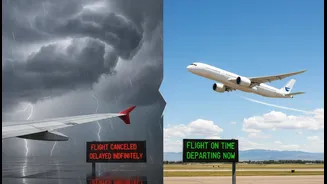







The Big Picture: A Network-Wide Puzzle
When a major weather event like a monsoon storm or dense winter fog hits a major airport, it doesn't affect all flights equally. Airlines and air traffic control work to keep the system moving, even if it's at a reduced capacity. The decision to cancel
one flight over another is a complex calculation made in an airline's operations control center, often with the help of sophisticated software. These systems weigh dozens of factors to produce the least amount of disruption across the airline's entire network. The goal is to prevent a single problem from creating a cascade of delays and cancellations across the country. Sometimes, cancelling one flight proactively can save five others from being disrupted later in the day.
Destination and En Route Weather Matter
The weather at your departure airport is only one piece of the puzzle. A flight from a clear-skied Mumbai to a cyclone-threatened Chennai will likely be cancelled, even if local conditions are perfect. Dispatchers and pilots look at the weather forecast for the entire flight path, not just the origin and destination. A line of severe thunderstorms between two cities can be just as prohibitive as a blizzard at the arrival airport, forcing costly and time-consuming reroutes or cancellations. If weather is expected to worsen during a long-haul flight, an airline might choose to cancel rather than risk having the plane, passengers, and crew stranded at an alternate airport.
The Hub and Spoke Calculation
Major airlines operate on a 'hub-and-spoke' model, where traffic is funnelled through large central airports like Delhi, Mumbai, or Bengaluru. During bad weather, protecting the integrity of these hubs is a top priority. A flight from a smaller city to a hub might be prioritized over a flight between two smaller cities because it carries dozens of connecting passengers. Conversely, if the hub itself is crippled by weather, airlines may pre-emptively cancel shorter regional flights that feed into it to reduce congestion and free up resources. This is done to protect the long-haul and international flights that are the arteries of the airline's network.
Aircraft and Crew Legality
Not all aircraft are created equal when it comes to weather. A smaller turboprop, for instance, has different wind limits than a large wide-body jet like a Boeing 777 or Airbus A350. Similarly, some aircraft are certified with more advanced landing systems (like a Category III ILS) that allow them to land in virtually zero visibility, while others are not. An even bigger factor is the crew. Aviation regulations impose strict limits on how long pilots and flight attendants can work. A weather delay, even a short one, can cause a crew to 'time out', meaning they would be illegal to operate the subsequent flight. Airlines often choose to cancel a flight if they know a delay will lead to a crew timing out, which would cause an even bigger disruption.
Downstream Operational Impact
Every decision has a ripple effect. An airline's control center knows where each specific aircraft and its crew are scheduled to be hours later. They might cancel a lightly-booked flight from Pune to Delhi in order to ensure the same aircraft is available to operate a full flight to London later that night. It's a strategic trade-off. They also consider passenger connections. A flight with a hundred passengers connecting to other flights might be prioritized over a flight where most people are ending their journey at the destination. While it might seem unfair, airlines use data to make the decision that inconveniences the fewest number of passengers across their entire system.