
Beyond Just Finding Water
For years, scientists have had tantalizing hints of water on the Moon. Now, the evidence is becoming concrete. Data from orbiters and impact probes, including India's Chandrayaan missions and NASA's Lunar Reconnaissance Orbiter, have moved from speculation
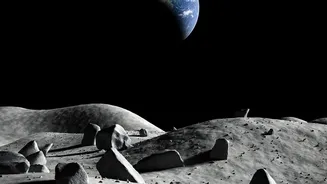
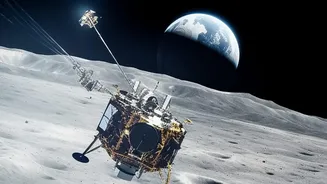
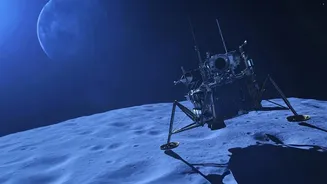
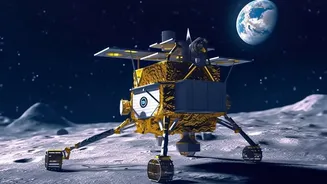
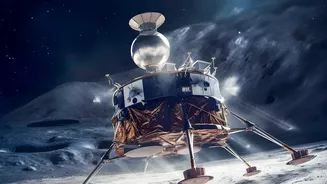
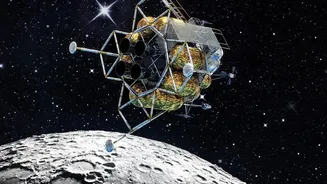
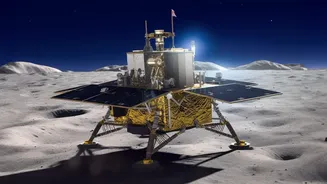
to mapping. The focus is on the Moon's south pole, a region of deep, permanently shadowed craters where temperatures are colder than Pluto, allowing water ice to remain frozen for billions of years. Missions like China's Chang'e-7, which launched in late August 2026, are specifically designed to prospect these dark craters with innovative 'hopper' drones to determine the concentration and accessibility of this ice. It’s no longer about if there is water, but how much there is and how we can get to it. New seismic techniques are even being developed to detect ice buried deep beneath the surface, hidden from orbital sensors.
From Lunar Ice to Rocket Fuel
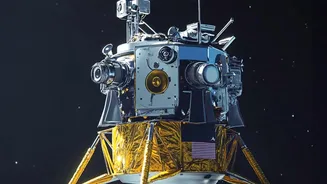
So, how does frozen water on the Moon power a mission to Mars? The concept is known as in-situ resource utilization (ISRU), which basically means living off the land. The process is straightforward chemistry. First, robotic miners would excavate the ice-rich lunar soil, or regolith. This material is then heated, causing the water ice to turn directly into vapor, which is collected and condensed. The real magic happens next through electrolysis: an electric current, likely generated by solar panels or a small nuclear reactor, splits the water (H2O) into its component parts: hydrogen and oxygen. When these elements are cooled to their liquid forms, they become a potent rocket propellant and oxidizer—the very same combination that has powered space missions for decades.
The Solar System's First Gas Station
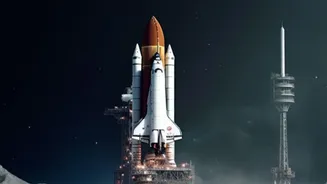
Creating fuel on the Moon is a game-changer because of something called the 'tyranny of the rocket equation'. In simple terms, the heavier your spacecraft, the more fuel you need to launch it. But that fuel has weight, which means you need even more fuel to lift the initial fuel. It’s a vicious cycle that makes missions to distant planets incredibly expensive and difficult. A lunar refuelling depot breaks this cycle. A spacecraft could launch from Earth with just enough fuel to get to the Moon, top up its tanks with locally-produced propellant, and then head off to Mars or beyond. According to NASA engineers, producing fuel on the moon could reduce a lander's launch mass from Earth by as much as 55%. This dramatically lowers costs and opens up possibilities for more ambitious, longer-duration missions. The Moon becomes not just a destination, but a critical launchpad to the rest of the solar system.
A New Race for Resources
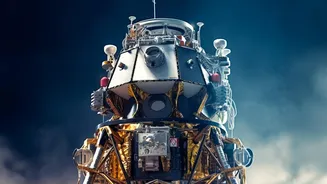
The strategic importance of lunar water has ignited a new, multipolar space race. Two major blocs are emerging. On one side is the U.S.-led Artemis Program, which involves commercial partners like SpaceX and Blue Origin and international agencies from Europe, Japan, and Canada. NASA aims to establish a permanent human presence on the Moon by 2028, with resource utilization as a core goal. On the other side is the China-Russia co-founded International Lunar Research Station (ILRS), which includes a growing list of partners. China aims for a human landing by 2030 and a fully operational robotic base by 2035, also at the coveted south pole. With valuable resources concentrated in limited areas, the risk of disputes over access and mining rights is very real, pushing the urgent need for international rules and governance.
The Cold, Hard Challenges
While the vision is compelling, building the Moon's first gas station is fraught with challenges. The permanently shadowed craters where water ice is most abundant are among the coldest places in the solar system, with temperatures dropping below -200°C. Operating machinery in such extreme cold is an immense engineering hurdle. The lunar regolith is abrasive and difficult to handle, and there's still a lack of high-resolution data on the precise location and purity of the ice deposits. Furthermore, any mining operation will be energy-intensive. Early missions will rely on solar power, meaning they must navigate a tricky balance between being close enough to sunlit areas for power and close enough to the dark craters for water. The long-term solution likely involves deploying small, portable nuclear fission reactors, which both the U.S. and China are developing.