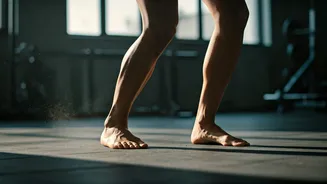









The Foundation of Your Strength
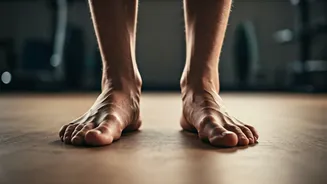
Think about the complex engineering of your feet. Each one contains 26 bones, 33 joints, and over 100 muscles, tendons, and ligaments. They are designed to be our primary interface with the ground, constantly sending feedback to the brain about terrain,
balance, and positioning. This sensory feedback system is called proprioception. However, we spend most of our lives encasing our feet in cushioned, supportive, and often restrictive shoes. While essential for protecting us on city streets, modern footwear can dull this vital connection. In the gym, this dulled feedback can mean a less stable base for crucial lifts like squats and deadlifts, leading to compromised form and potential injury.
Why Barefoot Training Works
When you train barefoot, you reawaken the thousands of nerve endings in your soles. This forces the small, intrinsic muscles in your feet and ankles to fire up and work harder to stabilise your body. A stronger, more active foot provides a more solid foundation. Imagine trying to build a tall, stable tower on a soft, wobbly mattress versus a hard, flat floor. Your body is the tower, and your feet are the ground beneath it. Barefoot mobility work essentially firms up that mattress into a reliable concrete slab, allowing for better force transfer up through your legs, hips, and core. This translates to improved balance, more efficient movement patterns, and a greater ability to generate power from the ground up.
Dynamic Mobility: The Active Warm-Up
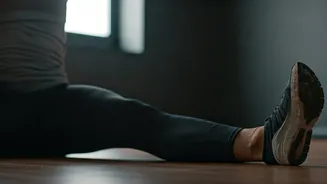
Forget holding a hamstring stretch for 30 seconds. Dynamic mobility involves actively moving your joints and muscles through their full range of motion. Unlike static stretching, which is best saved for after your workout, dynamic drills increase blood flow, raise your core temperature, and prime your nervous system for the work ahead. When you combine this with barefoot training, you get a double benefit: you’re not only preparing your major muscle groups but also activating the foundational stabilisers in your feet and ankles, ensuring your entire body is ready to perform safely and effectively.
Five Barefoot Drills to Try
Integrate these into your warm-up routine. Start on a clean, safe surface like a yoga mat or the rubber flooring in the stretching area of your gym. 1. **Ankle Rotations:** Stand on one leg (hold onto something for balance if needed). Slowly rotate your lifted foot in large circles, 10-15 times in each direction. This warms up the ankle joint. Doing it barefoot helps you feel the full range of motion without shoe restriction. 2. **Inchworms:** From a standing position, hinge at your hips and walk your hands out into a high plank. Your feet stay planted. Then, take tiny steps to walk your feet towards your hands. Barefoot, you'll feel your calves and hamstrings stretch while your toes and arches work to grip the floor. 3. **World's Greatest Stretch:** Step into a deep lunge. Place the hand on the same side as your front leg on the floor, inside your foot. Rotate your torso, reaching your other arm to the ceiling. Barefoot practice forces your front foot to grip and stabilise, activating the arch and improving hip mobility. 4. **Walking Lunges with a Twist:** Perform a standard walking lunge, but as you lower, twist your torso over your front leg. The lack of a shoe challenges your balance, forcing your foot, ankle, and hip stabilisers to work in concert. 5. **Barefoot Pogos:** Stand with feet shoulder-width apart and perform small, quick jumps on the balls of your feet, keeping your knees relatively straight. This builds elastic strength in your Achilles tendon and calf muscles, which is crucial for explosive movements.