

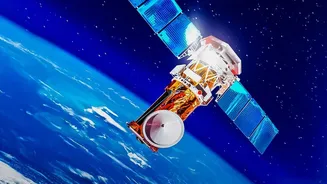
A Mission Within a Mission
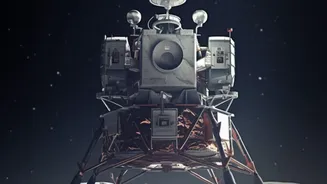
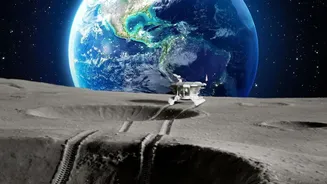
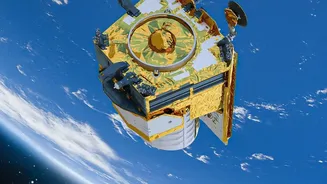
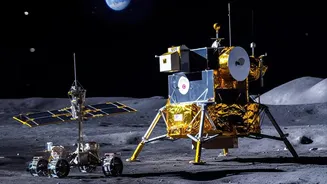
The primary goal for Chandrayaan-3 was clear: safely land the Vikram lander and deploy the Pragyan rover on the Moon's south pole. But ISRO engineers added a brilliant, value-added objective to the mission. The Propulsion Module, the part of the spacecraft
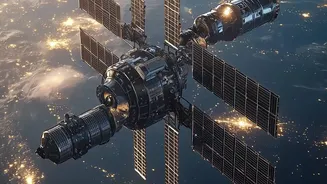
that carried the lander to its lunar orbit, was not just a ferry. It was equipped with a single, unique scientific instrument designed to observe Earth from its vantage point in lunar orbit. This effectively gave India two missions for the price of one, leveraging the journey to the Moon to conduct groundbreaking research about our own home.
Introducing the SHAPE Payload
The instrument at the heart of this secondary mission is called SHAPE, which stands for Spectro-polarimetry of Habitable Planet Earth. It was the only scientific payload on the Propulsion Module. SHAPE's job was to study the light reflected from Earth. Specifically, it looked at spectral and polarimetric measurements. Think of it this way: spectroscopy breaks down light into its constituent colours, revealing the chemical composition of the source (like our atmosphere), while polarimetry analyses the orientation of light waves, which can give clues about clouds and other atmospheric particles. By studying these signatures, ISRO aimed to create a detailed profile of a planet known to harbour life: our own.
Using Earth as a Blueprint
Why study Earth from so far away? The answer lies in the search for life on planets outside our solar system, known as exoplanets. Scientists are discovering thousands of exoplanets, but it's incredibly difficult to know if any of them are habitable. The SHAPE experiment was designed to treat Earth as if it were a distant exoplanet. By capturing the unique spectro-polarimetric 'fingerprint' of a life-bearing world, scientists can build a reference model. This model details what a habitable planet looks like from afar, including the signatures of its atmosphere, clouds, oceans, and vegetation. This data acts as a benchmark, a definitive template to compare against when we observe actual exoplanets in the future.
How the Observations Work
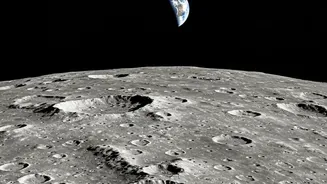
From its orbit around the Moon, the Propulsion Module had a unique and stable platform to observe the full, sunlit disk of Earth. As the Moon orbits Earth, SHAPE could capture data from different phase angles, meaning it could see our planet from various perspectives, much like how we see the phases of the Moon. The instrument operated in the near-infrared wavelength range, which is particularly useful for detecting key biosignatures. This allowed ISRO to gather long-term, consistent data on Earth's atmospheric composition, cloud cover, and other characteristics that signal habitability. This process essentially simulates how we would observe a potentially habitable exoplanet orbiting a distant star.
Pioneering Future Discoveries
The data gathered by SHAPE is more than just an academic exercise; it's a foundational step in one of astronomy's biggest quests. By understanding Earth's light signature in detail, future telescopes will be better equipped to spot similar patterns coming from distant worlds. For example, if a powerful future telescope detects an exoplanet with a spectro-polarimetric signature that matches the one SHAPE recorded for Earth, it would become a prime candidate for further investigation. This clever use of the Chandrayaan-3 mission, therefore, not only advanced our exploration of the Moon but also significantly contributes to the global search for life elsewhere in the universe, proving the incredible foresight and efficiency of India's space program.