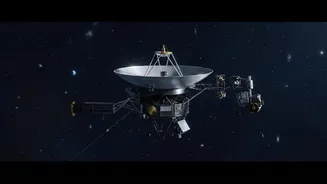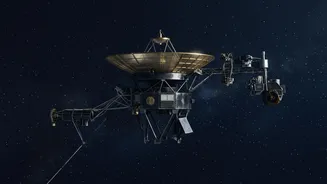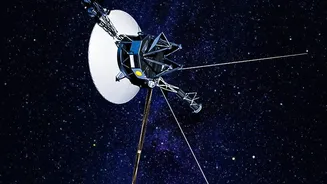



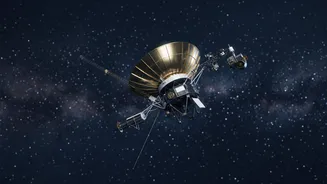
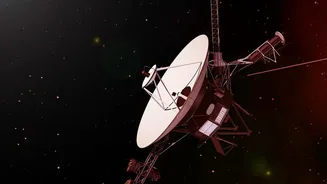
After 49 years spent hurtling through the cosmos, humanity’s most distant emissary, Voyager 1, fell silent. For two nail-biting days, it was lost to us. Now, contact is restored, sparking relief and raising questions about our oldest active space probe.
A Call from the Void
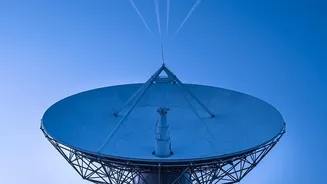
In the vast, silent expanse of interstellar space, over 25 billion kilometres from home, a faint voice returned. NASA engineers at the Jet Propulsion Laboratory (JPL) confirmed they had re-established a stable communications link with the Voyager 1 spacecraft. The restoration of contact followed a tense 48-hour period where the probe, an icon of space exploration launched in 1977, unexpectedly ceased transmitting data. During two scheduled check-ins, the giant antennas of the Deep Space Network heard only static, a worrying development for a craft that has been a reliable, albeit distant, companion for nearly half a century. The signal's sudden return, seemingly without direct intervention from its human creators, underscores both the resilience of the 1970s technology and the unpredictable nature of operating a machine in the space between stars.
The Loneliest Machine
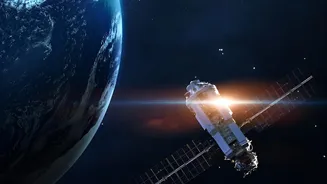
To appreciate the drama of the two-day silence, one must understand Voyager 1's incredible journey. Launched on September 5, 1977, its initial mission was to explore Jupiter and Saturn. After stunning flybys that revolutionised our understanding of the outer planets—revealing active volcanoes on Jupiter's moon Io and the complexities of Saturn's rings—its primary mission ended in 1980. But its journey was far from over. Voyager 1 continued outward, becoming the most distant human-made object in 1998. In August 2012, it achieved a monumental first: it crossed the heliopause, the boundary where the Sun’s influence ends, and entered interstellar space. It is the first and only active probe to directly sample the environment between the stars, travelling at over 61,000 kilometres per hour. A message sent to Voyager 1 now takes nearly a full day to arrive, meaning a simple 'hello' and its reply requires a two-day wait.
Diagnosing a Distant Patient
So, what caused the blackout? While engineers are still investigating the precise cause of this recent incident, they have some initial clues. The spacecraft’s fault protection system, an autonomous program designed to keep the probe safe, appears to have activated. It’s believed that one set of thrusters went offline, and its backup system automatically kicked in. This kind of event can place the spacecraft in a 'safe mode' to await instructions. This isn't the first time Voyager 1 has given its mission controllers a scare. The aging probe has experienced several age-related glitches in recent years. A similar issue in late 2023 involved the Flight Data System (FDS)—the computer that packages scientific and engineering data for transmission—sending back unreadable gibberish. In that instance, engineers spent months deciphering the problem, eventually tracing it to a single corrupted memory chip and cleverly writing code to bypass the damaged section. Each glitch serves as a reminder that operating a 49-year-old computer across billions of kilometres is a masterclass in long-distance problem-solving.
Why We Still Listen
With its cameras switched off decades ago to save power, Voyager 1 is no longer a photographer. Yet, its mission is far from over. A handful of instruments continue to operate, including a magnetometer and a plasma wave subsystem. These instruments provide unprecedented data about the interstellar medium—the cosmic sea of particles and magnetic fields that fills the space between star systems. The probe’s plutonium power source decays yearly, forcing engineers to make difficult decisions about which systems to shut down to conserve energy. Recent power saving manoeuvres were designed to extend the life of the remaining science instruments into the 2030s. Every bit of data it returns is a message from an unexplored frontier, a place no other active probe has ever been. It is a scientific treasure, helping us understand the galaxy our solar system inhabits.