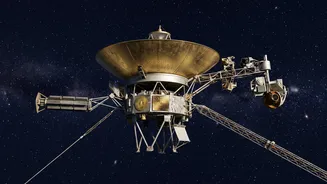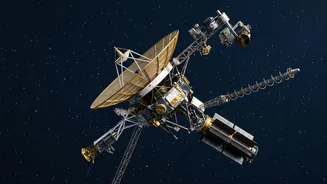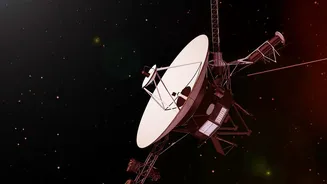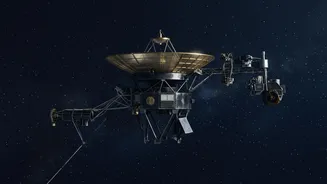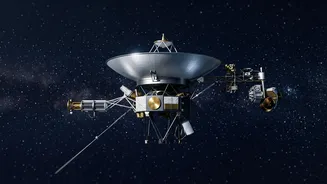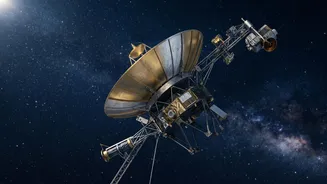





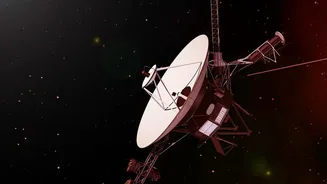
After nearly 50 years exploring the cosmos, humanity’s farthest envoy, Voyager 1, gave its creators a scare. A recent communication loss has been resolved, showcasing remarkable resilience as the probe approaches a truly historic milestone.
A Sudden, Puzzling Silence
In mid-October
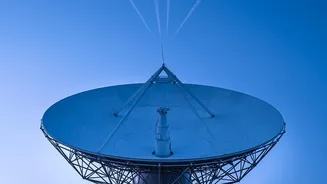
2026, NASA’s Deep Space Network, the sensitive array of global antennas that keeps in touch with distant probes, fell silent during two scheduled check-ins with Voyager 1. For roughly 48 hours, the spacecraft, travelling more than 25 billion kilometres away, did not phone home. This wasn't the first time Voyager 1 had experienced technical trouble; a more complex computer glitch in late 2023 took months of ingenious problem-solving to fix. But this new silence was different. To the relief of engineers, contact was re-established on October 20, not because of a command sent from Earth, but because the spacecraft appeared to have fixed itself.
An Automated Recovery
Engineers at NASA's Jet Propulsion Laboratory (JPL) are still piecing together the exact cause of the temporary outage. Initial analysis revealed that the spacecraft’s fault protection system had been activated automatically. This safety routine is programmed to engage when the onboard computers detect a problem. In this case, it appears one group of thrusters went offline, and the system correctly switched to a backup set, placing the probe into a stable 'safe mode' while doing so. While the recovery is welcome news, the event underscores the challenges of operating a nearly half-century-old probe. “This is the first time we've seen the spacecraft do something like this,” said Kareem Badaruddin, the Voyager mission manager at JPL, “but we are also at a point in the mission where we have to expect the unexpected.”
The 'Big Bang' Power-Saving Plan
The recent glitch occurred shortly after engineers completed a crucial power-saving maneuver nicknamed the 'Big Bang'. Launched in 1977, Voyager 1's nuclear power source, a radioisotope thermoelectric generator, naturally decays, losing about four watts of power each year. To prolong the life of its remaining science instruments, engineers in September 2026 carefully swapped three onboard devices for lower-power alternatives. This delicate, pre-planned operation was designed to save enough energy to prevent another instrument shutdown, which might have been necessary as early as mid-2027. It’s this kind of creative, long-distance engineering that has kept the mission alive far beyond its original planetary-flyby goals.
A Milestone Measured in Light
The successful recovery comes as Voyager 1 races toward an unprecedented achievement. On or around November 18, 2026, the spacecraft will become the first humanly made object to be one 'light_day' from Earth. A light_day is not a measure of time, but of distance: the approximately $25.9$ billion kilometres that light travels in $24$ hours. This milestone carries a practical significance that highlights the immense scale of Voyager’s journey. On that day, a radio command sent from Earth, travelling at the speed of light, will take a full $24$ hours to reach the probe. The team on the ground must then wait another $24$ hours for a response, making any troubleshooting a $48$-hour round_trip at minimum.
The Long Journey into Darkness
Having entered interstellar space in $2012$, Voyager $1$ left the protective bubble of our sun's influence and is now directly sampling the environment between the stars. Its original mission was to study Jupiter and Saturn, which it did spectacularly, but its extended life has transformed it into a pioneer of the interstellar medium. Even with dwindling power, it continues to send back valuable data on plasma waves, magnetic fields, and cosmic rays. While some instruments have been shut down to conserve energy, the mission could continue sending data into the next decade. After its power finally fades, Voyager $1$ will fall silent, continuing its journey through the Milky Way for eons to come, carrying its Golden Record as a silent ambassador from a distant world.