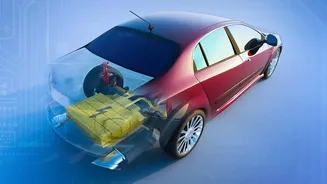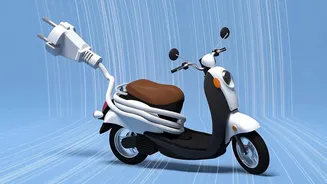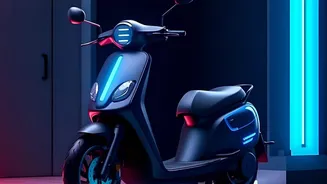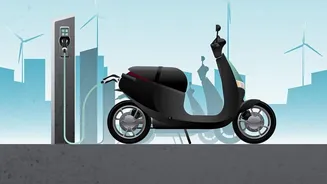







The Problem with Today's EV Batteries
For the average two-wheeler rider in India, the biggest hurdles to going electric have always been upfront cost and a nagging sense of anxiety. Will the battery last for the entire trip? How long will it take to charge? Is it safe? Most of these concerns
circle back to the lithium-ion batteries that power today's electric vehicles (EVs). While they are a huge improvement over older lead-acid technology, they have limitations. The liquid electrolyte inside them is flammable, which has led to rare but highly publicised fire incidents, creating safety concerns. They are also expensive to produce, partly due to the cost of materials like lithium and cobalt, which keeps the price of entry-level electric scooters higher than their petrol-powered counterparts. Finally, they degrade over time and can be sensitive to extreme temperatures, both hot and cold, affecting their performance and lifespan.
Enter the Solid-State Game-Changer
This is where solid-state batteries come in. The core innovation is simple to understand: they replace the flammable liquid electrolyte with a solid material, like a thin sheet of ceramic or a flexible polymer. This single change has massive benefits. First and foremost is safety. With no flammable liquid, the risk of fire from thermal runaway is virtually eliminated, making the batteries far more stable. Secondly, they are more energy-dense. This means they can store more energy in the same amount of space, which translates to a longer range for the scooter, or allows for a smaller, lighter battery pack without sacrificing performance. Developers are also reporting much faster charging times, with some prototypes claiming an 80% charge in under 15 minutes. This addresses one of the biggest pain points for EV owners: long waits at charging stations.
From the Lab to Indian Roads
For years, solid-state technology was confined to research labs. Now, it's moving into the real world. Globally, major players like Toyota and CATL are targeting initial production runs around 2027. More excitingly for the two-wheeler segment, some companies are moving even faster. Verge Motorcycles, a Finnish company, has already announced plans to deliver bikes with solid-state batteries. In India, the momentum is building. The government's push for clean energy and domestic manufacturing is creating a fertile ground for battery innovation. Several Indian companies, like Chennai-based Inventus Power and others in hubs like Pune and Bengaluru, are actively developing their own solid-state battery technologies. Inventus, for example, is working on a platform called Ceramion⁺™, an intrinsically safe system designed to work well in hot climates, making it ideal for Indian conditions. These local R&D efforts are crucial for creating batteries optimised for and made in India.
What 'Affordable' Could Actually Mean
The ultimate promise of solid-state technology is cost reduction. While current prototypes are more expensive to make than lithium-ion batteries, the long-term outlook is different. Solid-state batteries can use more abundant and cheaper materials, potentially reducing reliance on imported minerals. As manufacturing processes are scaled up and perfected, the cost per kilowatt-hour (kWh) is expected to drop significantly. The target for many developers is to achieve price parity with, and eventually become cheaper than, current lithium-ion batteries. For the Indian market, this could be revolutionary. If battery pack costs, which make up a significant portion of an EV's price, are slashed, we could see electric scooters priced competitively against the most popular 100-125cc petrol scooters. This would make EVs accessible to a much broader segment of the population, truly kickstarting a mass-market shift.
The Hurdles on the Horizon
Despite the immense promise, a dose of reality is needed. The journey from successful trials to mass-market availability is filled with challenges. The biggest hurdle is manufacturing at scale. Producing the solid electrolyte layers with consistent quality and at a low cost is a complex engineering problem that companies worldwide are racing to solve. While some firms are targeting pilot production by 2027, large-scale mass adoption is more realistically expected closer to 2030. Furthermore, these batteries will need to prove their durability and performance over thousands of cycles in real-world Indian conditions, from monsoon humidity to scorching summer heat and congested city traffic. While early signs are positive, widespread commercialisation will depend on overcoming these final technical and economic barriers.