






An Earth-Like Laboratory
In our solar system, Titan is unique. It is the only moon with a thick atmosphere, which is four times denser than Earth's. This atmosphere is mostly nitrogen, just like ours, but it's rich in methane and other organic compounds. This complex carbon chemistry
is what makes Titan such a compelling destination for scientists. These organic molecules are the basic building blocks of life as we know it. The conditions on Titan today are thought to be similar to those on early Earth, before life emerged, making the moon a natural laboratory for studying prebiotic chemistry. By exploring Titan, scientists hope to understand the chemical pathways that could have led to the origin of life on our own planet and potentially elsewhere.
A World of Rivers and Seas
Titan features a landscape that is shockingly familiar, with rivers, lakes, and seas. However, instead of water, these bodies are filled with liquid methane and ethane due to the moon's frigid surface temperature of around -179 degrees Celsius. The moon has weather, clouds, and rain, all part of a methane cycle that mirrors Earth's water cycle. Beneath its icy crust, evidence strongly suggests the existence of a vast liquid water ocean. This combination of abundant complex organic material on the surface and the potential for liquid water to have interacted with it in the past—perhaps from impacts that melted the ice—makes Titan a prime target for astrobiology. The mission aims to investigate sites where this mixing of water and organics might have occurred.
The Revolutionary Dragonfly Rotorcraft
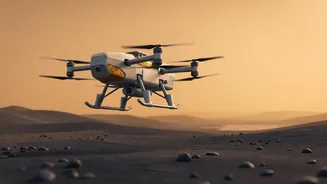
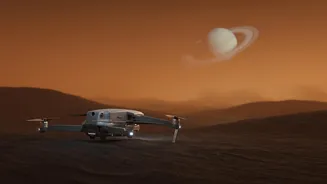
To explore this dynamic world, NASA is sending a revolutionary vehicle called Dragonfly. It is a dual-quadcopter, essentially a large drone with eight rotors, about the size of a small car. While previous missions relied on stationary landers or slow-moving rovers, Dragonfly will be able to fly. Taking advantage of Titan's low gravity and thick atmosphere makes flight much easier than on Earth or Mars. This mobility is a game-changer, allowing the craft to travel tens of kilometers in a single flight, far beyond what any rover could achieve in a day. The plan is for Dragonfly to make a series of 'hops,' flying to dozens of different locations to sample and analyze the diverse geology and composition of the moon's surface.
The Mission Timeline and What's Next
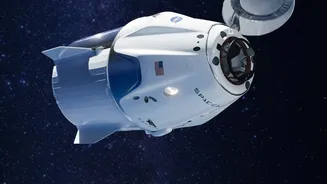
The Dragonfly mission is scheduled to launch on a SpaceX Falcon Heavy rocket in July 2028. Due to the vast distance, the journey will take over six years, with arrival at Titan expected in 2034. Once there, the rotorcraft will begin its primary science mission, which is planned to last for about 3.3 years. During this time, Dragonfly will spend most of its time on the ground, conducting scientific experiments with its suite of instruments, which includes a mass spectrometer to study the composition of surface materials and a drill to acquire samples. It will be powered by a Multi-Mission Radioisotope Thermoelectric Generator (MMRTG), a nuclear power source that provides constant electricity and warmth in the extreme cold, recharging its batteries between flights. The team will command Dragonfly to fly about once every Titan day, which is equivalent to 16 Earth days.