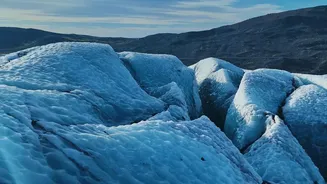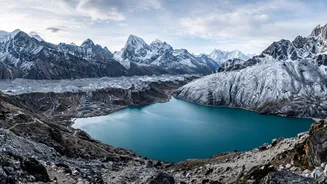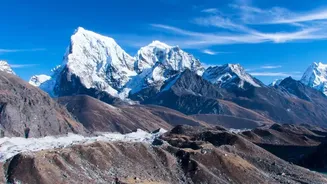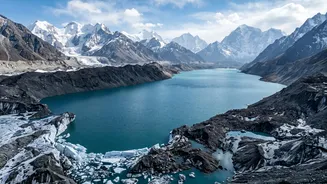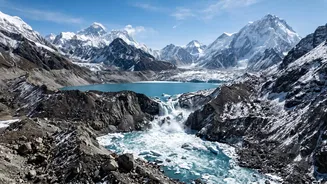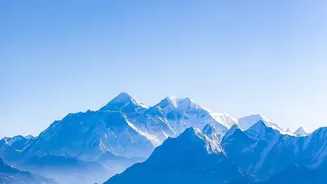




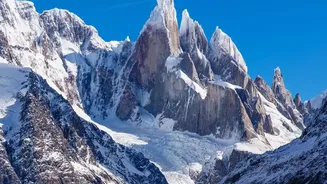
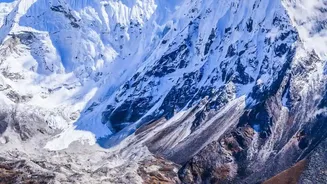
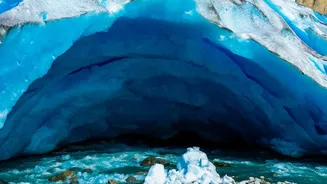
The Himalayas, often called the 'Third Pole', are a vital water source for nearly two billion people. But as new reports cited by the United Nations warn, these magnificent glaciers are melting at an alarming rate, creating a deadly new reality.
A Crisis Unfolding in Real Time
Recent
reports from the International Cryosphere Climate Initiative (ICCI), backed by the United Nations Environment Programme (UNEP), paint a stark picture. Released in early November 2026, the 'State of the Cryosphere 2026' report highlights that the rate of ice loss from Himalayan glaciers has doubled since the year 2000. According to the International Centre for Integrated Mountain Development (ICIMOD), this has resulted in glaciers losing up to 27 metres of ice thickness since 1975. This isn't a distant threat; it's a crisis with immediate consequences. UN officials have warned that millions of people living downstream, along with critical infrastructure like hydroelectric power plants, are in jeopardy. The reports stress that even if global warming is limited to 1.5°C, about one-third of the glacier ice in the Hindu Kush Himalaya region could still vanish.
The Terrifying Threat of GLOFs
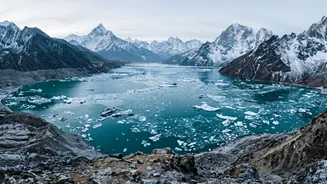
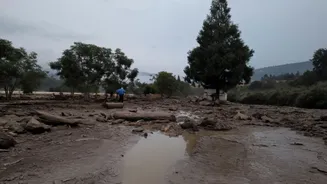
The primary and most immediate danger from this rapid melting is the increased risk of Glacial Lake Outburst Floods, or GLOFs. A GLOF is a catastrophic flood that occurs when the natural dam containing a glacial lake fails. These dams, often made of loose rock and sediment called moraine, can become unstable as meltwater collects behind them. When they breach, they release an enormous volume of water, mud, and boulders downstream at high velocity, capable of destroying everything in their path. The frequency of these events is rising. Data shows that the average number of GLOFs per decade in the Himalayas is now nearly five times higher than it was before 1950. The tragic flash flood in Nepal in August 2026, which killed over a thousand people, was a devastating example of a similar mountain hazard, where a massive collapse of rock and glacier ice triggered a disaster. These events serve as a brutal illustration of the growing risks.
India's Vulnerable Frontiers
For India, this is a frontline issue. The Hindu Kush Himalaya region feeds ten major Asian river systems, including the Indus, Ganga, and Brahmaputra, which are lifelines for vast populations. A UN-led pre-publication study has grimly noted that between 1835 and 2025, India recorded the highest number of deaths from GLOFs among eight Himalayan countries, with over 6,000 fatalities. There are over 2,000 glacial lakes mapped across the Indian Himalayan Region, and many are considered potentially dangerous. Recent assessments have identified dozens of high-risk glacial lakes in India that directly threaten downstream communities, roads, and infrastructure. The danger is not just from lakes within India's borders; transboundary GLOFs are also a major concern. A recent outburst at Shintaphu Lake in Bhutan prompted immediate flood warnings for districts in West Bengal and Assam, highlighting the interconnected nature of the threat.
A Dual Crisis: Too Much Water, Then Too Little
The tragic irony of the melting glaciers is that they present a dual crisis. In the short term, the threat is from too much water in the form of catastrophic floods. But in the long term, the issue will be a critical lack of water. Glaciers are natural storehouses of freshwater, regulating river flows throughout the year. As they shrink, river flows initially increase, but scientists predict that most Himalayan river basins will reach 'peak water' by mid_century. After that, as the glaciers' stored ice diminishes, river flows will steadily decline. This threatens water security for agriculture, drinking water supplies, and hydropower generation for hundreds of millions of people across the Indian plains. The World Bank has warned that climate_induced water scarcity could shrink the GDP of South Asian nations significantly by 2050.