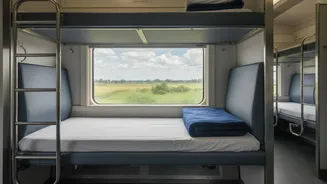








The Sanctuary in the Sky
The upper berth's single greatest advantage is privacy. Once you make the climb, that space is yours for the entire journey. You can sleep, read, or listen to music without interruption. Unlike the lower berth, which serves as a communal bench during
the day, the upper berth is a personal zone that no one will ask to share. This makes it a favourite for solo travellers and those who want to disconnect. If you have an overnight journey and wish to sleep early or wake up late, the upper berth allows you to do so without waiting for others to settle down. Many also find it safer for belongings, as bags can be tucked into a corner near your head.
The Climb and Other Compromises
The most obvious drawback is the physical effort required. Climbing up and down can be a hassle, especially at night or for frequent trips to the washroom. This makes it unsuitable for elderly passengers, pregnant women, or individuals with mobility issues. Another common complaint is the reduced headroom; sitting up comfortably can be a challenge, particularly for taller people. The upper berth is also often closer to the main lights and AC vents, which can lead to a very cold or brightly lit night's sleep. Finally, you sacrifice the window view, a cherished part of any scenic train journey in India.
Convenience at Ground Level
The lower berth is the champion of convenience. There is no climbing involved, making it the default choice for senior citizens and families with young children. In fact, Indian Railways has a specific quota to allot lower berths to senior citizens and women over 45, subject to availability. You get direct access to the window for views, easy entry and exit from the coach, and proximity to charging points, which are often located on the main panel between the lower seats. During the day, it offers the most comfortable seating.
The Social Seat
The biggest downside to the lower berth is the lack of privacy. From morning until around 10 p.m., your berth is the designated seating area for the middle and upper berth passengers. This means sharing your space, dealing with constant movement, and having limited personal time to lie down and rest during the day. While it can be a great way to socialise and meet fellow travellers, it can be a significant drawback for those seeking a quiet journey. Your sleep can also be disturbed by people moving about in the aisle or conversations happening nearby.
The Side Berth Equation
The side berths offer a different set of trade-offs. The Side Lower berth provides a window view and seating for two during the day, which converts into a single berth at night. While it offers some independence, it is directly exposed to the aisle traffic. The Side Upper berth is a favourite for many solo female travellers, offering a high degree of privacy, especially in AC coaches with curtains. However, it is important to note that side berths are often slightly shorter than main berths, which can be a squeeze for taller passengers.
A Berth for Every Traveller
Ultimately, the best berth depends entirely on your travel style and priorities. For solo travellers, especially women, seeking privacy and uninterrupted sleep, the upper or side upper berth is often the best bet. For senior citizens, people with medical conditions, or families travelling with kids, the convenience of the lower berth is unmatched. If you are on a short day trip, a lower berth guarantees a window seat. For a long overnight journey where sleep is paramount, the climb to the upper berth might be a price worth paying for peace.