



Prepare for a Month of Stargazing
July 2026 is an exciting month for sky lovers, but success depends on preparation. The biggest challenge for many in India will be the monsoon weather, so checking your local forecast for clear skies is the first step. For the best views, find a location
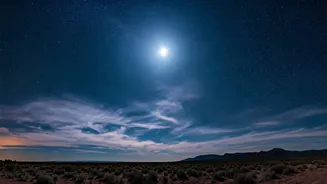
away from city lights. Light pollution can wash out fainter stars and meteors. Give your eyes at least 20-30 minutes to fully adapt to the darkness. While many of this month's events are visible to the naked eye, a pair of binoculars or a small telescope can dramatically enhance the view, revealing details like the moons of a planet or the dense star fields of the Milky Way. Stargazing apps can also help you identify constellations and locate the planets mentioned below.
Early July: Planets on Parade
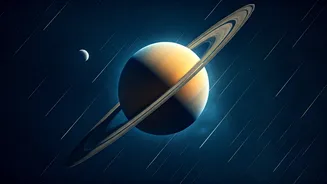
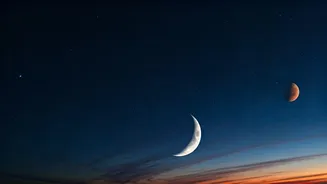
The month kicks off with several notable planetary events. On the night of July 7, the Moon will appear close to Saturn. The ringed planet, which looks like a steady, golden star, will rise after midnight in the eastern sky and travel in tandem with the Moon until dawn. A few mornings later, on July 11, a thin crescent Moon will form an attractive triangle with orange-hued Mars and the beautiful Pleiades star cluster, also known as the Seven Sisters. Look for this trio in the eastern sky about two hours before sunrise. Then, on July 13, Mars will have a close encounter with the bright, reddish star Aldebaran in the constellation of Taurus, creating a striking pair in the pre-dawn sky.
Mid-July: The Best Time for Deep Sky Views
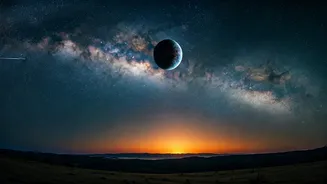
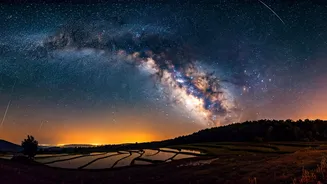
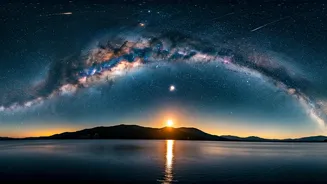
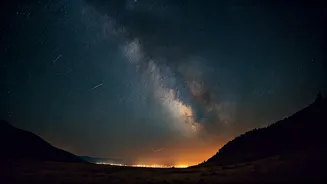
The middle of the month presents a golden opportunity for observers with clear, dark skies. The new Moon on July 14 means there will be no moonlight to interfere with observations, creating ideal conditions for viewing faint objects. This is the perfect time to look for the majestic sweep of our own galaxy, the Milky Way. From a dark location, it appears as a hazy, luminous band stretching across the sky. For those with binoculars, scanning this band reveals countless stars, clusters, and nebulae. On July 17, a slim crescent Moon will have a close conjunction with the brilliant planet Venus shortly after sunset in the west, offering a beautiful but brief spectacle.
Late July: A Double Meteor Shower
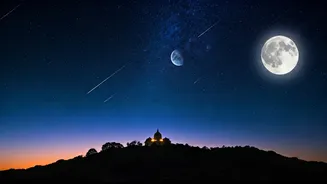
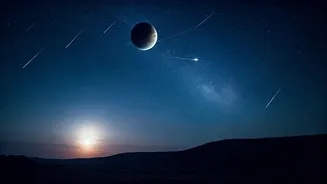
The end of July brings not one, but two meteor showers peaking on the same nights: the Southern Delta Aquariids and the Alpha Capricornids. Both showers are active for several weeks but are expected to reach their peak activity on the nights of July 30 and 31. The Delta Aquariids are known for a steady rate of meteors, potentially 15-20 per hour under perfect conditions, though they are often faint. The Alpha Capricornids produce fewer meteors, around five per hour, but are famous for their exceptionally bright and sometimes colourful fireballs. Unfortunately, in 2026, a nearly full Moon will rise on these nights, and its bright glare will wash out all but the most brilliant meteors. The best strategy is to watch in the week before the peak, when the Moon is less of a factor.
The Full Buck Moon and Guru Purnima
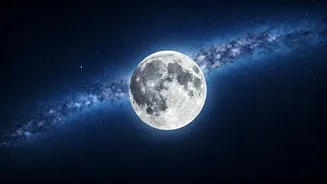
July's full Moon, which rises on July 29, is traditionally known as the Buck Moon. In 2026, its peak illumination will coincide with the Hindu festival of Guru Purnima. While the bright moonlight will hinder meteor watching around this date, the full Moon itself is a spectacle. Look for it to rise in the east around sunset. You might notice it appears larger and more orange when it's near the horizon—an effect known as the Moon Illusion. In the pre-dawn hours around the full moon, you can also spot Saturn, Mars, and Mercury forming an arc across the sky, tracing the path that the planets follow.