


Jaipur has captured the global spotlight once again, earning a coveted spot on National Geographic’s ‘Best of the World 2027’ list. This honour, timed with the city's 300th anniversary, celebrates its living history and architectural splendour.
A City Born from a Blueprint
Long before
modern urban planning, Jaipur was conceived as India's first planned city in 1727 by the visionary Maharaja Sawai Jai Singh II and his architect Vidyadhar Bhattacharya. Moving from the congested Amber, the new capital was laid out on a grid based on ancient Hindu architectural principles known as Vastu Shastra. The city was divided into nine blocks, with wide, straight avenues intersecting at right angles—a marvel of organisation designed to be a bustling centre for commerce and trade. This foundational genius is a key reason for its 2019 inscription as a UNESCO World Heritage site, recognised for its unique blend of ancient Hindu, Mughal, and Western planning concepts.
The Iconic Hawa Mahal
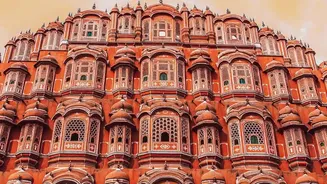
No image of Jaipur is more iconic than the Hawa Mahal, or 'Palace of Winds'. Built in 1799 from distinctive red and pink sandstone, this five-storey facade is not a palace in the traditional sense, but an elaborate screen. Its 953 intricately latticed windows, or 'jharokhas', were designed for a specific purpose: to allow the royal women to observe street festivals and daily life unseen, adhering to the purdah system. Architecturally, it is also a masterpiece of climate control. The honeycomb design creates a Venturi effect, funnelling cool breezes through the interior, making it a pleasant retreat from the summer heat. Many visitors are surprised to learn that this famous facade is actually the rear of the building, which is part of the larger City Palace complex.
The Majestic Forts on the Hill
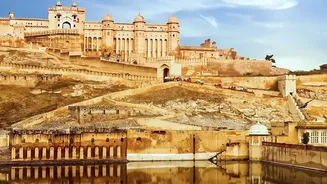
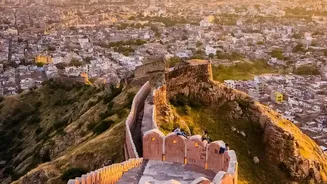
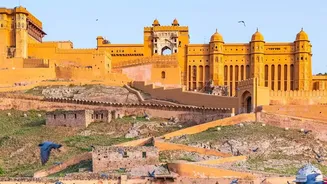
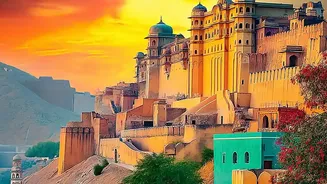
Guarding the city from the surrounding Aravalli hills are a trio of magnificent forts, each with its own character. The most famous, Amer Fort, was the seat of the Kachwaha dynasty before Jaipur was built. It is a stunning example of Rajput-Mughal architecture, constructed from red sandstone and marble. Its sprawling complex includes opulent palaces like the Sheesh Mahal (Mirror Palace) and public audience halls. Nearby, Jaigarh Fort was built as a military stronghold to protect Amer, while Nahargarh Fort offers the most spectacular panoramic views of Jaipur. Together, they tell a story of royal power, strategic defence, and artistic grandeur.
The Heart of the City: City Palace
At the centre of Jaipur's original grid lies the City Palace, the royal residence established by Sawai Jai Singh II. Still home to the royal family, this sprawling complex is a destination in itself, featuring a breathtaking fusion of Rajput, Mughal, and even European architectural styles. Visitors can wander through courtyards, gardens, and galleries, including the Mubarak Mahal, once a reception hall for foreign dignitaries. One of the most photographed spots is the Pritam Niwas Chowk, a courtyard with four exquisitely decorated gates, each representing a different season. The complex also houses the Maharaja Sawai Man Singh II Museum, which displays royal costumes, weaponry, and art, offering a glimpse into the city's regal past.
Architectural Gems Beyond the Palaces
Jaipur's architectural genius extends beyond its forts and palaces. The Jantar Mantar, another UNESCO World Heritage site, is an 18th century open air astronomical observatory featuring the world's largest stone sundial. It stands as a testament to the scientific prowess of its founder. For a different kind of architectural experience travellers should seek out Panna Meena Ka Kund, a 16th century stepwell near Amer Fort. These 'baoris' were vital for water management in arid Rajasthan but also served as community gathering places. The perfectly symmetrical crisscrossing staircases of Panna Meena Ka Kund create a dizzying and beautiful geometric pattern offering a peaceful escape and a look into the practical ingenuity of the past.