


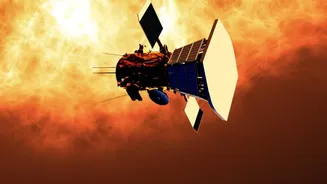
Our Unblinking Eye on the Sun
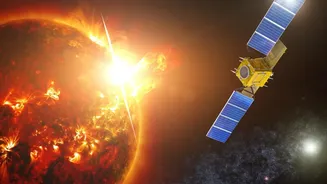
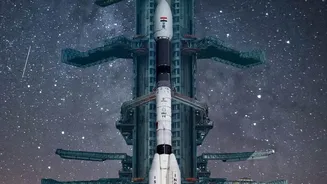
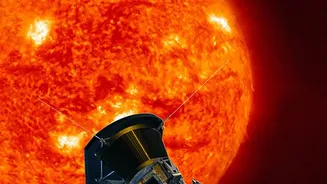
Aditya L1 is ISRO's first dedicated solar observatory, a testament to India's growing prowess in space science. It is strategically positioned in a halo orbit around the Sun-Earth Lagrange point 1 (L1). This unique spot allows the spacecraft to have a continuous,
uninterrupted view of the Sun, without any eclipses or occultations caused by the Earth or Moon. Think of it as the ultimate solar lookout post. From this vantage point, Aditya L1 observes the Sun and samples the solar wind—the stream of charged particles flowing from the Sun—long before it reaches our planet. This gives scientists a crucial head start, providing an early warning of potentially hazardous space weather.
Understanding the Fury of a Solar Storm
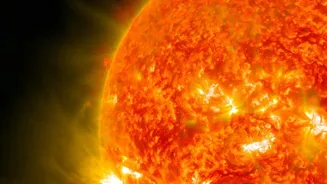
The Sun, while the source of all life on Earth, is not always benevolent. It periodically unleashes solar flares, which are intense bursts of radiation, and Coronal Mass Ejections (CMEs), which are massive explosions of plasma and magnetic fields. When these are directed at Earth, they can cause geomagnetic storms. While these storms create beautiful auroras, they also pose a significant threat to our modern, technology-dependent civilisation. They can disrupt satellite communications and navigation systems like GPS, damage power grids leading to blackouts, and pose a risk to astronauts and high-altitude flights. Protecting India's own growing fleet of over 50 satellites and critical ground infrastructure is a key driver behind the mission.
A Seven-Fold Toolkit for Solar Analysis
To achieve its goals, Aditya L1 is equipped with a suite of seven sophisticated instruments, each designed to study a different aspect of the Sun. Four of these are remote-sensing payloads that observe the Sun's atmosphere, while the other three are in-situ instruments that measure the environment at the L1 point. The Visible Emission Line Coronagraph (VELC) is a primary instrument that studies the Sun's outermost layer, the corona, and tracks CMEs as they erupt. The Solar Ultraviolet Imaging Telescope (SUIT) provides full-disk images of the photosphere and chromosphere in wavelengths never continuously observed before, helping scientists understand the transfer of energy that fuels solar eruptions. Other instruments like SoLEXS and HEL1OS monitor X-rays from flares, while ASPEX and PAPA analyse the solar wind and its particles. A magnetometer measures the interplanetary magnetic field.
From Raw Data to Actionable Warnings
The true power of Aditya L1 lies in how this data is used. By combining observations from its various instruments, scientists can build a comprehensive picture of what the Sun is doing in real-time. For instance, when VELC sees a CME lift off from the corona and SUIT observes the associated flare on the surface, the in-situ instruments can then measure the speed and magnetic orientation of the incoming particle cloud. This gives a warning of 30-60 minutes before the storm hits Earth. This data is fed into sophisticated models run by space weather centres at ISRO and partner institutes. These models help forecast the arrival time and potential intensity of a solar storm, turning raw data into actionable alerts for satellite operators, power grid managers, and airlines to take protective measures.
The Indian Advantage in a Global Effort
Aditya L1 marks a significant shift for India, moving it from being just a user of space weather data to a key producer. The mission is not just about scientific discovery; it's about building self-reliance in protecting our national interests. The data helps safeguard India's critical space assets, including the NavIC navigation system, and strengthens the resilience of our digital economy and power infrastructure. By making its data available to the global scientific community, ISRO also enhances international collaboration in heliophysics research and space weather prediction. Early findings have already helped scientists decode how solar storms compress Earth's magnetic shield, providing new insights crucial for protecting satellites in geostationary orbit.