

The Challenge of Living Off-World
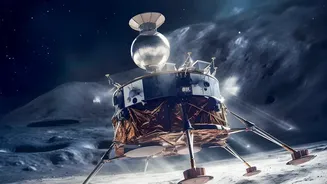
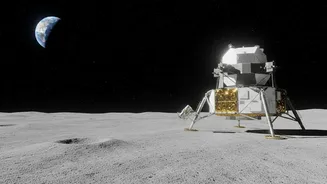
Establishing a sustainable human presence on the Moon, a key goal of NASA's Artemis program, is less about rocket science and more about logistics. Every kilogram of food, water, and equipment must be launched out of Earth's formidable gravity well, a process
that costs thousands of dollars. The most critical and heaviest consumable is oxygen. It's not just for breathing; it's also a vital component (an oxidizer) for rocket propellant needed to launch vehicles from the lunar surface for return trips or missions deeper into space. Transporting the sheer volume of oxygen required for a long-term habitat and refueling station would be astronomically expensive, making self-sufficiency not just a goal, but a necessity.
An Unexpected Abundance of Oxygen
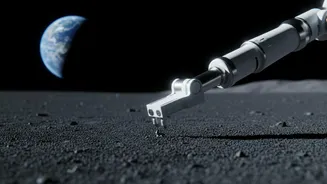
The Moon has virtually no atmosphere, but its surface is surprisingly rich in oxygen. The gray dust and crushed rock covering the Moon, known as regolith, is composed of about 45% oxygen by weight. This oxygen isn't a gas floating around; it is chemically locked inside oxide minerals, combined with elements like silicon, aluminum, iron, and titanium. For decades, scientists have theorized that if they could devise a way to break these strong chemical bonds, they could unlock a nearly limitless supply of breathable air and rocket oxidizer right on the lunar surface. This practice of using local materials is called in-situ resource utilization, or ISRU, and it's seen as a revolutionary step for space exploration.
How to 'Breathe' a Rock
Several methods are being developed by NASA and its partners, like the European Space Agency (ESA) and private companies including Sierra Space and Blue Origin, to extract this trapped oxygen. Two leading techniques are molten regolith electrolysis and carbothermal reduction. In molten regolith electrolysis, the lunar soil is heated to extreme temperatures (around 1,700°C) until it melts. An electric current is then passed through the molten rock, which causes the oxygen to separate and collect at an electrode, much like how electrolysis splits water into hydrogen and oxygen. Carbothermal reduction involves heating the regolith to a high temperature in a reactor and introducing a reducing agent like methane. This process pulls the oxygen out of the minerals to form carbon monoxide, which can then be converted to produce breathable oxygen.
More Than Just Air
The benefits of processing lunar regolith extend far beyond oxygen. The leftovers from these extraction processes are a mixture of valuable metals. Once the oxygen is removed, what remains are elements like iron, aluminum, and silicon. These metals could be used as raw materials for construction and manufacturing on the Moon. Imagine using a 3D printer to create tools, spare parts, or even building blocks for habitats from these extracted metals. This dual-purpose capability dramatically increases the value of ISRU, turning a single process into a foundational technology for building a self-sustaining lunar outpost. Blue Origin's Blue Alchemist project, for instance, has demonstrated creating solar cells and glass from the byproducts.
From Earth-Based Labs to the Lunar Surface
This technology is no longer just theoretical. At NASA's Johnson Space Center, the Carbothermal Reduction Demonstration (CaRD) project has successfully used a solar concentrator to simulate the power of the sun to heat regolith simulant and extract oxygen in a vacuum. Similarly, tests at Kennedy Space Center have proven that the process can be scaled up. Private companies are also making huge strides. However, significant challenges remain. The equipment must be robust enough to operate in the harsh lunar environment, with its extreme temperature swings and abrasive, electrostatically charged dust. Furthermore, these processes are energy-intensive, and any lunar base will need a powerful and reliable energy source, likely solar, to run them. The final proof will come from technology demonstration missions planned as part of the Artemis program, which will test these systems on the Moon itself.