



The Quest for a Permanent Foothold
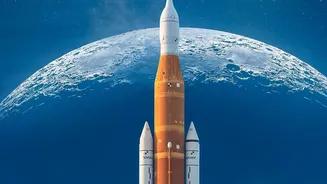
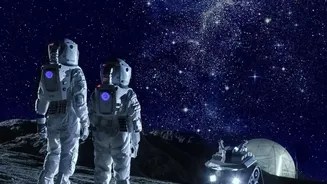
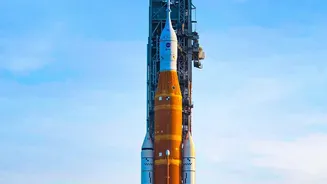
For decades, space missions have been like camping trips—short stays with all supplies packed from home. NASA's Artemis program is planning a paradigm shift: establishing a permanent base on the Moon. This isn't just about planting a flag; it's about creating
a sustainable outpost for science and a stepping stone for future missions to Mars. However, the single biggest obstacle to long-term stays in space is the enormous cost and difficulty of launching every single kilogram of supplies from Earth. Every bottle of water, every oxygen tank, and every drop of fuel adds immense weight and expense to a mission. To make a lunar base viable, astronauts need to live off the land, a concept known as In-Situ Resource Utilization (ISRU). This is where the Moon's south pole becomes the most valuable real estate in the solar system.
A Frozen Treasure in Perpetual Darkness
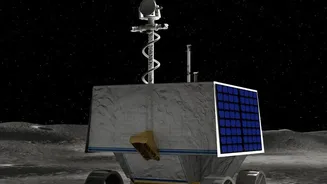
The south pole of the Moon is a land of extreme contrasts. While some areas are bathed in near-constant sunlight, perfect for solar panels, the floors of many deep craters have not seen the sun in billions of years. These "permanently shadowed regions" are among the coldest places in our solar system. This extreme cold acts as a perfect trap, preserving volatile compounds like water ice that would otherwise be destroyed by solar radiation. Data from various missions, including NASA's Lunar Reconnaissance Orbiter and India's groundbreaking Chandrayaan-3, which successfully landed in the region in 2023, have confirmed the presence of this water. This isn't a skating rink of surface ice; scientists believe it exists as ice crystals mixed in with the lunar soil, or regolith. Finding and extracting this ice is the primary objective for early Artemis missions.
More Than Just a Drink
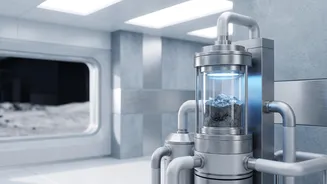
The most obvious use for lunar water is, of course, for the astronauts themselves. Providing drinking water and water for growing food would slash the amount of critical supplies that need to be ferried from Earth. But the true value of water ice goes far beyond life support. Using a process called electrolysis, electricity (generated by solar panels in nearby sunlit areas) can split water molecules (H2O) into their component parts: hydrogen and oxygen. The oxygen is a game-changer. It can be used to create a breathable atmosphere inside habitats, making long-duration stays possible without relying on heavy, finite oxygen tanks from Earth. This single capability fundamentally alters the logistics of lunar living, turning a hostile environment into one that can be managed for the long term.
The Ultimate Refueling Station
The second product of electrolysis, hydrogen, combined with the oxygen, creates a powerful, clean rocket propellant. This is perhaps the most revolutionary aspect of lunar water ice. It means the Moon could become a cosmic gas station. Rockets traveling from Earth could launch with just enough fuel to get to the Moon, refuel there, and then continue on to more distant destinations like Mars. Spacecraft returning to Earth could also top up their tanks for the journey home. This solves one of the biggest challenges in rocketry: the tyranny of the rocket equation, which dictates that the more fuel you need to carry, the heavier your rocket becomes, which in turn requires even more fuel just to lift off. Producing propellant on the Moon breaks this vicious cycle, making deep space exploration more affordable and feasible than ever before.