


A New Twist on the Sun's Surface
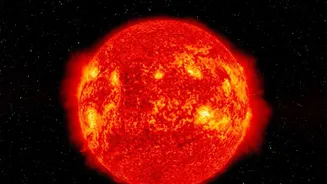
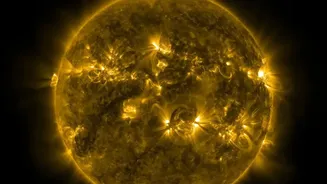
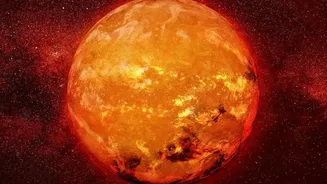
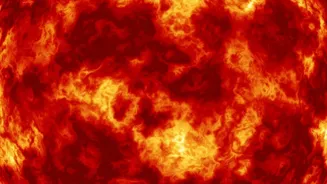
Using the world's most powerful solar telescope, scientists have captured the highest-resolution images ever of the sun's surface, known as the photosphere. These images revealed something astounding: tiny, swirling vortices of hot plasma, some as small
as 20 kilometers wide. These whirlpool-like patterns are the first direct observation of a long-theorized phenomenon called Kelvin-Helmholtz instability on the sun. This instability occurs when two fluids, or in this case plasmas, flow past each other at different speeds, creating a shear force that develops into vortices—similar to how wind creates waves on water. While seen in clouds and on other planets like Jupiter, spotting these intricate dances on our own star is a landmark achievement.
A Feat of Telescopic Power
This discovery was made possible by the National Science Foundation's Daniel K. Inouye Solar Telescope in Hawaii. Its massive four-meter mirror allows astronomers to see details on the solar surface with unprecedented clarity. Resolving these small vortices is like being able to spot a small coin from nearly 180 kilometers away. Researchers from institutions including the National Solar Observatory and the Max Planck Institute combined the telescope's sharp observations with sophisticated computer simulations to confirm what they were seeing. The simulations, based on the laws of physics, predicted the formation of these very structures, providing strong evidence that these are indeed Kelvin-Helmholtz instabilities in action.
Solving a Major Solar Puzzle
So why do these tiny swirls matter? For decades, one of the biggest puzzles in solar physics has been the coronal heating problem: why the sun's outer atmosphere, the corona, is hundreds of times hotter than its visible surface. The corona can reach millions of degrees Celsius, while the surface is a relatively cooler 5,500 degrees. These newly seen vortices could be a key part of the answer. Scientists believe the constant twisting motion of these plasma whirlpools generates and transports magnetic energy from the surface up into the corona. This process could act as a heating mechanism, helping to solve the long-standing temperature mystery.
The Engine of Solar Eruptions
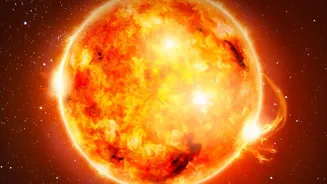
Beyond heating, these instabilities play a crucial role in the sun's more violent behavior. The twisting and coiling of magnetic field lines by these vortices builds up immense energy, like a tightly wound spring. When this energy is suddenly released, it can trigger massive solar events like solar flares and coronal mass ejections (CMEs). These are gigantic explosions that hurl radiation and charged particles into space. By understanding how and where this energy builds up at a small scale, scientists can develop better models for predicting these large-scale solar eruptions.
Protecting Our Technology on Earth
Understanding solar eruptions isn't just an academic exercise; it has significant real-world implications. The high-energy particles released during solar storms can create hazardous space weather that threatens our technologically dependent society. These storms can disrupt satellite operations, interfere with GPS navigation and global communications, and even damage power grids on the ground. By providing a clearer picture of the fundamental processes driving solar activity, this discovery is a major step toward more accurate and reliable space weather forecasting. Better forecasts give us more time to protect our critical infrastructure and astronauts in space from the sun's powerful outbursts.