



A Tsunami of Data
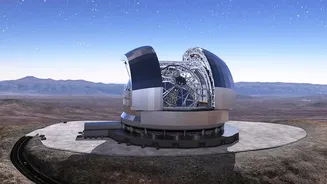
Modern astronomical surveys are less about looking and more about data management on an unthinkable scale. Telescopes no longer just capture pretty pictures; they are digital data factories. The upcoming Vera C. Rubin Observatory in Chile, for instance,
will capture about 20 terabytes of data every single night. To put that in perspective, you would have to stream high-definition video continuously for years to use that much data. Over its ten-year mission, it will amass a database of around 15 petabytes. Other projects like the Square Kilometre Array (SKA) are projected to collect a petabyte of data daily. This colossal volume of information cannot simply be downloaded and sifted through on a laptop. It requires supercomputing power, sophisticated data pipelines, and dedicated science platforms just to store, process, and make the data accessible to researchers around the globe. The first major hurdle in finding a rare object is simply navigating this digital ocean.
Hunting for Cosmic Ghosts
Not all cosmic objects shine brightly. Many of the universe's most sought-after prizes—distant galaxies, exotic stars, or clues to dark matter—are incredibly faint. Astronomical surveys face a fundamental trade-off: they can either scan a huge patch of sky with less detail, or they can stare deeply at a small area to capture faint light. To map the whole sky, surveys must move relatively quickly, which limits their ability to detect the dimmest objects. It's like trying to spot a glow-in-the-dark sticker in a sunlit room. Making matters worse, the sky itself is becoming brighter. The proliferation of low-Earth orbit satellite constellations creates bright streaks across images, contaminating data and raising the overall background brightness of the sky. This electronic light pollution makes it even harder to pick out the faint signals of distant, rare phenomena from the noise.
Blink and You'll Miss It
Many of the most exciting events in the universe are transient, meaning they change on human timescales. Think of a supernova—the explosive death of a star—or a kilonova, the cataclysmic merger of two neutron stars. These events flare up and then fade away, sometimes in a matter of hours or days. To find them, you not only have to be looking in the right place, you have to be looking at exactly the right time. Modern surveys tackle this by repeatedly imaging the same sections of the sky. The Rubin Observatory will survey the entire visible sky every few nights, creating a time-lapse movie of the cosmos. When its software detects a change between images, it generates an alert. The challenge? It's expected to generate up to 10 million of these alerts every night. Somewhere in that flood of data might be a once-in-a-generation discovery, but finding it requires filtering out millions of more common variable stars and data artifacts in near real-time.
The Bias in the Code
With millions of alerts and billions of catalogued objects, it's impossible for humans to check everything by eye. Astronomers rely on sophisticated machine learning algorithms to automate the search. However, these algorithms present their own problem: they are often trained to find things we already know exist. This creates an inherent bias against discovering something truly new or unexpected. An algorithm trained to identify supernovae might miss a completely novel type of cosmic explosion because it doesn't fit the established pattern. Researchers are now developing specific anomaly detection software to hunt for these outliers. The goal is to flag anything that looks weird, but this is a difficult task. The software has to be smart enough to distinguish between a genuine scientific anomaly and a simple data-processing error, a satellite streak, or a known but rare type of object.
The Human-Machine Partnership
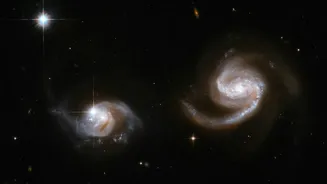
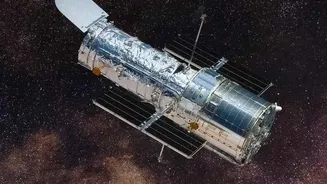
While automation is essential, the human brain remains one of the best pattern-recognition tools available. The future of cosmic discovery lies not in replacing human astronomers, but in augmenting them. The most effective approach is a human-machine partnership. AI can do the heavy lifting, sifting through petabytes of data to flag a few thousand potentially interesting anomalies. Then, human experts can step in to examine these candidates, using their intuition and experience to separate the truly strange from the mundane. This active learning process, where humans provide feedback to the AI, makes the system smarter over time. Recent projects using this method on archival data from the Hubble Space Telescope have already uncovered hundreds of previously undocumented anomalous objects, such as interacting galaxies and gravitational lenses. This proves that even in an age of big data, the curious human mind is the ultimate discovery engine.