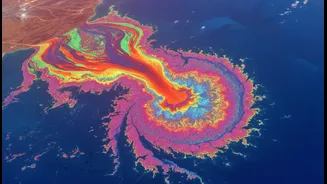








The Green and Red Menace
They go by many names—red tides, brown tides, or cyanobacteria blooms—but are collectively known as harmful algal blooms (HABs). These are not just any algae; they are rapid, explosive growths of specific microscopic species that can produce potent toxins.
These toxins can be devastating, killing fish, marine mammals, and birds. They can also accumulate in shellfish, posing a serious risk to human health if consumed. Beyond the direct poisoning, the sheer mass of a bloom can cause problems. When the algae die and decompose, the process consumes vast amounts of oxygen in the water, creating hypoxic "dead zones" where most marine life cannot survive. These events disrupt ecosystems and can cripple coastal economies that rely on fishing and tourism.
Following the Nutrient Trail
So, what supercharges these blooms? The primary culprits are nutrients, specifically nitrogen and phosphorus. While these elements are essential for life in moderation, an excess acts like a super-fertilizer for algae. This 'overfeeding' often originates on land from sources like agricultural runoff carrying fertilizers, discharges from wastewater treatment plants, and urban storm runoff. These nutrient-laden freshwaters flow through rivers and streams and eventually empty into coastal zones. When combined with other factors like warm water temperatures and ample sunlight, conditions become perfect for an algal bloom to ignite. Climate change can exacerbate this by causing more extreme weather events, which can increase runoff, and by warming surface waters.
An Orbital Watchdog
This is where space technology provides a revolutionary advantage. Monitoring vast stretches of coastline and open ocean from boats is slow, expensive, and often means you only find a bloom after it has already grown massive. Satellites, however, offer a persistent, wide-angle view, allowing scientists to monitor entire regions frequently. Agencies like NASA and the European Space Agency use a fleet of Earth-observing satellites—such as the Landsat series, Terra, Aqua, and the Copernicus Sentinels—to keep a constant watch on water quality around the globe. The latest generation of satellites, like NASA's PACE mission, are equipped with even more advanced sensors specifically designed for this kind of work.
Seeing the Invisible with Infrared
While satellites can't directly measure nitrogen or phosphorus in the water, they can detect the effects of these nutrients with remarkable precision using sophisticated sensors. Many of these sensors are hyperspectral, meaning they see light in many more wavelengths than the human eye, extending into the near-infrared (NIR) and shortwave infrared (SWIR) parts of the spectrum. Algae contain chlorophyll, the same pigment that makes plants green. Different types of algae have unique spectral signatures, like a fingerprint, based on how they reflect and absorb light. By analyzing these signatures, scientists can not only detect a bloom but often identify the type of algae present. For example, chlorophyll has a distinct reflectance peak in the green part of the visible spectrum and another in the near-infrared, which sensors can easily pick up. Some algal species even emit a faint red glow (fluorescence) during photosynthesis, which can also be detected from space.
From Data to Action
The real breakthrough is connecting the bloom to the runoff. Satellites can't see the runoff itself, but they can see its impact. By tracking changes in water color, temperature, and chlorophyll concentration over time, scientists can identify the plumes of nutrient-rich water as they flow from rivers into the sea and watch how they spread. By combining this satellite imagery with data on land use, rainfall, and river discharge rates, researchers can use computer models to trace these plumes back to their likely sources on land. Recently, artificial intelligence is being used to fuse data from multiple satellites, making detection faster and more accurate. This information is invaluable for environmental agencies. It helps them target their water sampling efforts more effectively, issue timely public health warnings, and ultimately work with communities and industries upstream to reduce the nutrient pollution that fuels these devastating blooms in the first place.