


A Cosmic Shadow Play
At its heart, a lunar eclipse is simple: it happens when the Moon passes directly into Earth's shadow. Just like you can cast a shadow on a wall, our planet casts a massive shadow into space. Most of the time, the Moon's path around the Earth misses this
shadow. But a few times a year, everything lines up perfectly, and the Moon glides through the darkness cast by our world. This can only happen during the full moon phase, which is when the Moon is on the opposite side of Earth from the Sun.
The Perfect Alignment
For an eclipse to occur, the Sun, Earth, and Moon must be in an almost perfect straight line. This alignment causes Earth to block the Sun's light from reaching the Moon directly. Earth's shadow actually has two parts: a faint, outer shadow called the penumbra, and a much darker, inner shadow called the umbra. The type of eclipse we see depends on which part of the shadow the Moon passes through. A lunar eclipse is a slow, gradual process, often lasting for several hours from start to finish, and is visible from anywhere on the night side of Earth.
Why Not Every Full Moon?
If a lunar eclipse requires a full moon, you might wonder why we don't have one every single month. The reason is that the Moon's orbit is tilted. It's not on the same flat plane as Earth's orbit around the Sun. Instead, the Moon's orbit is tilted by about 5 degrees. This means that during most full moons, the Moon passes either slightly above or slightly below Earth's shadow in space. Eclipses only happen on the rare occasions when the full moon occurs just as the Moon is crossing the plane of Earth's orbit, allowing it to pass right through the shadow.
Shades of an Eclipse
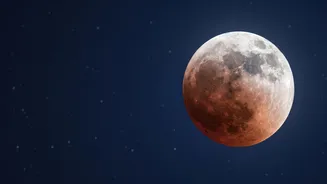
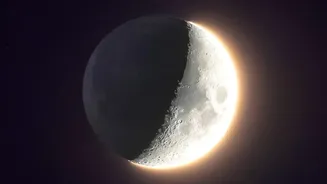
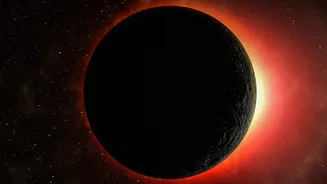
There are three main types of lunar eclipses. The most dramatic is a total lunar eclipse, where the entire Moon passes through Earth's dark umbra. A partial lunar eclipse occurs when only a part of the Moon enters the umbra, making it look like a dark bite has been taken out of it. The third type is a penumbral eclipse, which happens when the Moon only passes through the faint outer shadow. These can be very subtle and difficult to notice; the Moon just dims slightly.
The 'Blood Moon' Explained
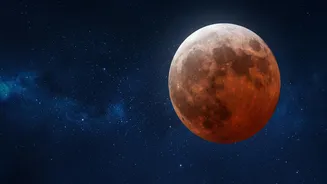
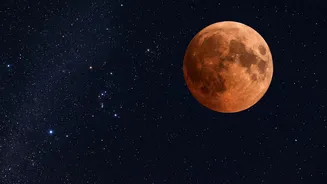
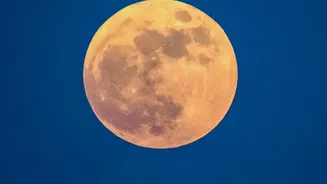
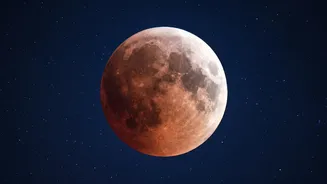
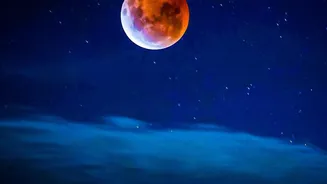
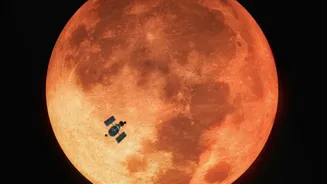
During a total lunar eclipse, the Moon doesn't usually disappear completely. Instead, it often glows with a reddish-orange hue, earning it the popular nickname "Blood Moon." This happens because Earth's atmosphere acts like a filter. As sunlight passes through our atmosphere, it scatters the shorter-wavelength blue light but allows the longer-wavelength red and orange light to pass through and bend around the planet. This reddish light then illuminates the Moon's surface. In essence, you are seeing the light of all the sunrises and sunsets on Earth being projected onto the Moon. The exact shade of red depends on how much dust and cloud cover is in Earth's atmosphere at the time.