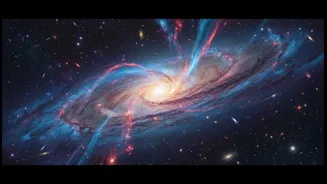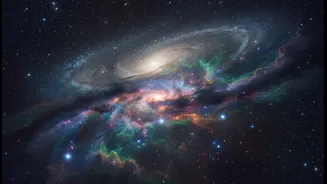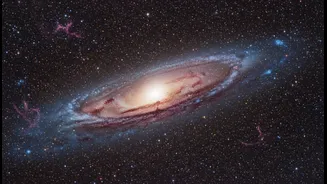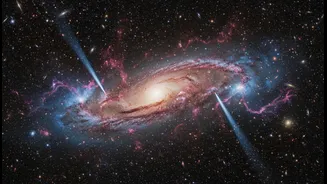





A Celestial Collision in Plain Sight
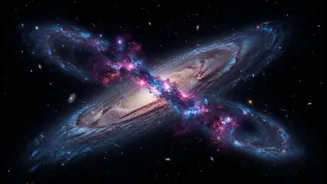
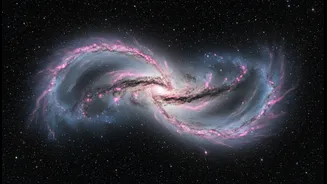
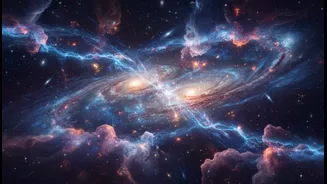
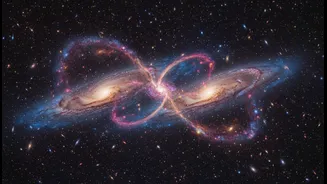
When galaxies, each containing billions of stars, get too close, gravity takes over. They pull and tug at each other in a chaotic dance that can last hundreds of millions of years. A prime example captured by the James Webb Space Telescope (JWST) is Stephan's
Quintet, a group of five galaxies, four of which are locked in a gravitational embrace. One of these galaxies, NGC 7318B, is an intruder, smashing through the group at a staggering 1.8 million miles per hour. This cosmic pile-up isn't just a demolition derby; it's a creative force, and for the first time, we're seeing the powerful mechanisms at play.
Seeing the Invisible Shockwaves
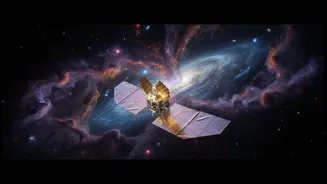
The incredible speed of this galactic collision generates enormous shockwaves, far larger than our own Milky Way galaxy. These aren't sound waves traveling through air, but vast fronts of superheated gas and dust being violently compressed. To most telescopes, including the Hubble, these areas are obscured by thick dust. But JWST is a technological marvel designed specifically to see the universe in infrared light, which can penetrate these dusty veils. Using its Mid-Infrared Instrument (MIRI), Webb has been able to map out these huge shockwaves in unprecedented detail, revealing a roiling, turbulent environment between the galaxies.
The Technology Driving Discovery
The ability to see these shockwaves is a testament to the advanced technology aboard the JWST. Its combination of the Near-Infrared Camera (NIRCam) and MIRI allows astronomers to create composite images that differentiate between stars, cool dust, and the intensely heated gas of the shockwaves. In the images of Stephan's Quintet, specialists assigned specific colors to the data from each instrument, making the shock fronts stand out in brilliant reds and golds. This isn't just for a pretty picture; it allows scientists to analyze the temperature, composition, and movement of gas in these violent encounters, something that was impossible before Webb.
A Cosmic Recycling Plant
So, what do these shockwaves actually do? They act like giant particle accelerators and cosmic recycling plants. As the shock front plows through the interstellar medium, it creates a highly turbulent zone where clouds of cold molecular hydrogen gas—the fuel for star formation—are disintegrated and then reformed. Interestingly, this process doesn't immediately lead to a burst of new stars as one might expect. Scientists are still working to understand why this recycled material seems to be 'sterile' for star formation, a challenge for current theories of galaxy evolution. The shockwaves essentially churn and redistribute the raw materials that will eventually build future generations of stars and planets.
A Glimpse into the Milky Way's Future
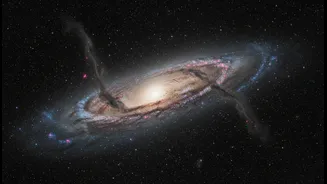
Studying galactic mergers like Stephan's Quintet or IC 1623 isn't just about understanding distant objects; it's also a preview of our own cosmic destiny. The Milky Way is on a collision course with our nearest large neighbor, the Andromeda galaxy, with the merger expected to begin in about 4.5 billion years. By observing these distant collisions, astronomers can build and refine models of what will happen when our own galactic home undergoes a similar transformation. The images from JWST are providing a crucial, real-world laboratory for testing our understanding of how galaxies evolve through these violent but essential interactions, which are a fundamental process in the life of the universe.