



Meet Our New, Tiny Neighbour
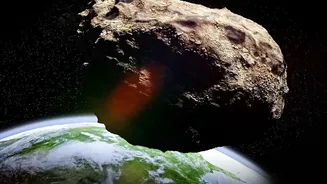
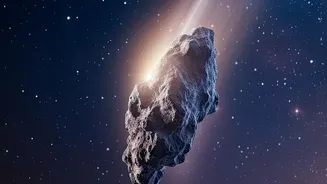
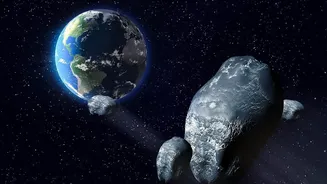
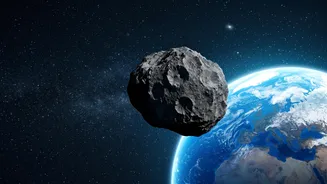
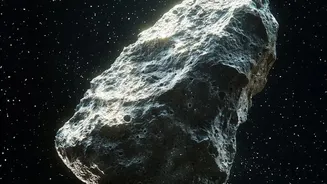
Our solar system neighbourhood has a new, temporary resident. Astronomers have confirmed the presence of 2026 QQ8, a small asteroid measuring just a couple of metres across, about the size of a car. In April 2026, this wandering space rock strayed too
close to our planet and was pulled into a temporary orbit by Earth's gravity, earning it the informal title of 'mini-moon'. The term isn't an official scientific classification, but it's used to describe natural objects that become temporarily bound to Earth. This isn't the first time Earth has had a short-term companion; asteroids like 2006 RH120 and 2020 CD3 have had similar orbital stays. These events are thought to be quite common, but the objects are so small and faint that they are incredibly difficult to detect.
The Delicate Dance of Capture
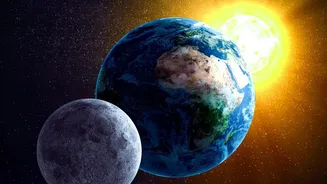
So how does a planet like ours capture a moon, even a mini one? It's all about a delicate gravitational dance. 2026 QQ8 was already orbiting the Sun on a path similar to Earth's. As it approached our planet, it entered a region in space known as the Hill sphere, where Earth's gravity is the dominant force. The combined gravitational pull of the Earth and our much larger, permanent Moon was enough to coax the asteroid out of its own solar orbit and into a looping, chaotic path around us. Think of it like a marble rolling across a complex surface with several dips; the largest dip is the Sun, but smaller ones from Earth and the Moon can temporarily trap a passing object if its speed and trajectory are just right.
An Unstable, Fleeting Orbit
The very same forces that brought 2026 QQ8 to us are the ones that will push it away. Its orbit isn't a stable, nearly circular path like that of our main Moon. Instead, it follows a complex, lopsided loop, a signature of Temporarily Captured Objects (TCOs). These orbits are inherently unstable because the mini-moon is caught in a gravitational tug-of-war. While Earth's gravity holds it for now, the much more powerful gravity of the Sun and the constant nudging from our own large Moon work to disrupt its path. Most mini-moons only stay for a few months, completing a few orbits before being flung back out into space.
A Cosmic Goodbye
Astronomers predict that 2026 QQ8's time with us will end soon. By early December, the constant gravitational perturbations will give it the push it needs to escape Earth's influence. Once free, it won't be flying off to a distant galaxy. Instead, it will simply resume its old life, re-entering a stable orbit around the Sun as a near-Earth asteroid. There is no danger of it hitting our planet; at its small size, it would harmlessly break up in the atmosphere if it were on a collision course. Its path is well-calculated, and its departure will be a quiet, cosmic event happening hundreds of thousands of kilometres away.
Why These Visitors Matter
While mini-moons like 2026 QQ8 are fleeting visitors, they are a scientific goldmine. Studying them provides valuable information about the population of asteroids near Earth, many of which originate from the main asteroid belt between Mars and Jupiter. Some may even be fragments blasted off our own Moon's surface by ancient impacts. Because they come so close, they are ideal targets for future, low-cost sample-return missions that could help us understand what these small celestial bodies are made of. Each new discovery helps astronomers refine their models and improves our ability to detect these tiny, fast-moving objects, enhancing our understanding of the ever-changing environment in our corner of the solar system.