






A Galaxy's Violent, Dusty Heart
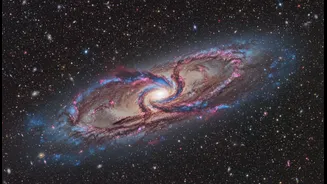
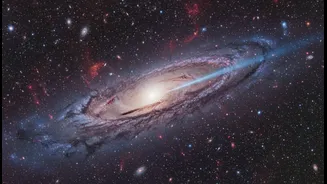
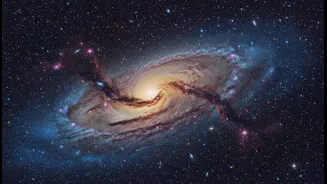
Located about 11 to 13 million light-years away, Centaurus A is not just any galaxy; it's the result of a colossal merger between a large elliptical galaxy and a smaller spiral one roughly two billion years ago. This cosmic crash has left it with a peculiar
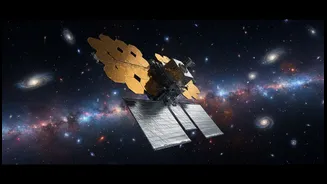
structure, defined by a warped central disk of gas and dust. At its heart lies a supermassive black hole, 55 million times the mass of our Sun, that actively feeds on surrounding material and blasts out powerful jets of energy. Previous telescopes like Hubble struggled to see past the thick dust that shrouds the galaxy's core. But Webb's powerful infrared instruments, MIRI (Mid-Infrared Instrument) and NIRCam (Near-Infrared Camera), have pierced through this veil, revealing the galaxy's active centre and millions of individual stars with stunning clarity.
Unlocking Secrets of Galactic Evolution
The new images, released to mark the fourth anniversary of Webb's science operations, are more than just pretty pictures; they are a treasure trove for astronomers worldwide. By resolving individual stars, scientists can now perform a kind of 'galactic archaeology'. They can distinguish between different generations of stars—those that existed before the merger, those formed during the collision, and those born in its aftermath. This helps create a detailed timeline of the galaxy's evolution. Furthermore, observing the interplay between the central black hole and its surroundings provides a close-up view of how these cosmic engines shape their host galaxies—sometimes triggering star birth by compressing gas, and at other times halting it by pushing material away. Understanding this feedback loop in Centaurus A helps scientists refine their models of galaxy formation across the universe.
The Growing Indian Connection
The excitement around Webb's discoveries has a strong echo in India, which has a deep and growing engagement with the world's most powerful space telescope. Several scientists of Indian origin hold key positions within the Webb telescope team, including Dr. Hashima Hasan, a Deputy Program Scientist, and Kalyani Sukhatme, who was a project manager for the MIRI instrument. Beyond personnel, Indian research institutions are direct participants in Webb's scientific explorations. Scientists from institutes like the Tata Institute of Fundamental Research (TIFR) and the Indian Institute of Science, Education and Research (IISER) are among the select groups awarded observation time on the telescope for their research projects. For example, Indian teams are using Webb to study the birth of stars and planets in regions vastly different from our own solar neighbourhood.
A Multi-Wavelength Future
The relevance of the Centaurus A image is further amplified by India's own world-class astronomical facilities. Centaurus A has long been a prime target for multi-wavelength studies, combining data from radio, X-ray, and visible light telescopes to build a complete picture. India operates the Giant Metrewave Radio Telescope (GMRT) near Pune, one of the world's most sensitive radio telescope arrays at low frequencies. This facility is perfectly suited to study the large-scale radio jets emanating from Centaurus A's black hole. By combining the high-resolution infrared data from Webb with radio data from facilities like GMRT and X-ray data from India's AstroSat space observatory, researchers can create a far more comprehensive model of the galaxy's physics. This synergy places Indian astronomers in a prime position to contribute significantly to the ongoing global effort to understand this fascinating object.