


What Is Space Weather?
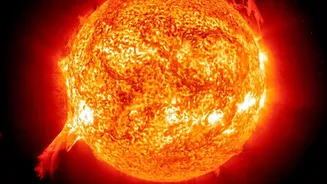
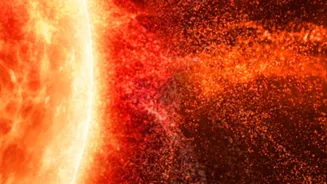
Space weather refers to the changing conditions in space, driven by the Sun's activity. Unlike weather on Earth, it doesn't involve wind or rain. Instead, it’s about massive eruptions of energy and particles from the sun. Key phenomena include solar flares,
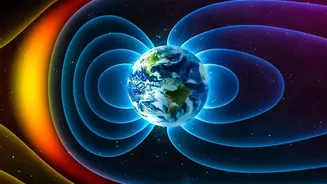
which are intense bursts of radiation, and coronal mass ejections (CMEs), which are giant clouds of solar plasma and magnetic fields hurled into space. When these events are aimed at Earth, they can interact with our planet's magnetic field and upper atmosphere, triggering geomagnetic storms that have tangible effects on technology.
The Threat to Our Orbital Infrastructure
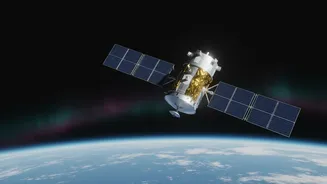
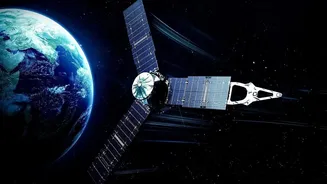
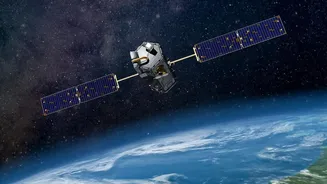
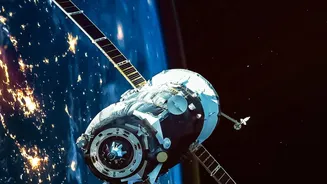
Satellites are particularly vulnerable to this solar onslaught. Energetic particles from the sun can damage or destroy sensitive electronics on board, leading to malfunctions or complete failure. Geomagnetic storms also heat and expand Earth's upper atmosphere. This increases atmospheric drag on satellites in low-Earth orbit (LEO), causing them to lose altitude faster than expected and potentially re-enter the atmosphere prematurely if their orbits aren't corrected. Furthermore, these disturbances can disrupt the radio signals that travel between satellites and the ground, degrading GPS accuracy and even causing total signal loss. This interference affects everything from navigation systems to the high-frequency financial trading that relies on precise satellite timing.
A Sky More Crowded Than Ever
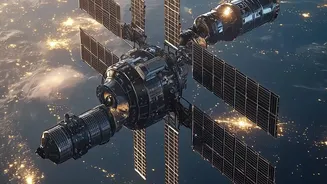
The risk is intensifying as our reliance on space grows exponentially. We are in the era of satellite mega-constellations. Companies like SpaceX's Starlink and Amazon's Project Kuiper are deploying thousands of LEO satellites to provide global broadband internet. Starlink already has over 10,000 satellites in orbit, with plans for tens of thousands more. These networks promise to connect underserved regions and support the next generation of 5G and IoT devices. However, this proliferation of LEO satellites creates a much larger, more complex system that is highly exposed to the effects of space weather, where a single significant event could disrupt services for millions.
The Race to Predict the Sun's Mood
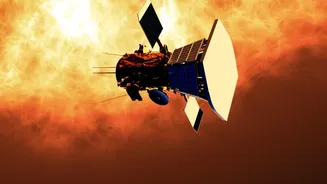
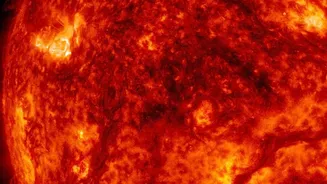
The core challenge is that predicting space weather is incredibly difficult. While forecasters on Earth can see storms coming days in advance, a CME can travel from the Sun to Earth in just a few days, sometimes less, leaving little time to prepare. Current forecasting relies on observing the Sun's surface for indicators like sunspots and monitoring the solar wind from spacecraft positioned between the Sun and Earth. Organizations like the US National Oceanic and Atmospheric Administration (NOAA) are constantly working to improve their models, using techniques like data assimilation and machine learning to increase warning times. New research aims to get a more accurate picture of the Sun's magnetic field, which is key to anticipating when and where disruptive events will occur.
Building a Resilient Future
With the global space economy projected to be worth over a trillion dollars by 2040, the stakes are enormous. A severe solar storm could cause billions of dollars in economic losses per day, not just from direct damage but from cascading failures in power grids, supply chains, and financial services. Improving space weather science is therefore not just an academic pursuit; it's an economic and security imperative. Better forecasting, led by institutions like NASA and various university research centers, would give satellite operators more time to take protective measures, such as temporarily shutting down sensitive components or maneuvering spacecraft. It allows for a move from a reactive to a proactive approach, ensuring the satellite networks we increasingly depend on can withstand the Sun’s inevitable fury.