




More Than Meets the Eye
When we gaze at a stunning image of the Pillars of Creation or the Carina Nebula, we're not seeing what our eyes would if we were somehow able to travel thousands of light-years away. Much of the universe's most dramatic action, especially the birth of stars,
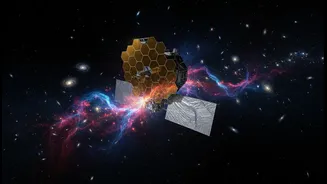
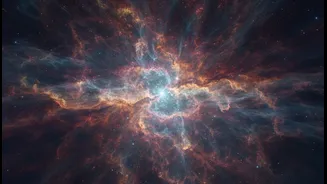
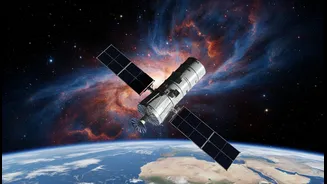
happens shrouded in thick clouds of gas and dust. This dust acts like a cosmic fog, blocking visible light. To peer inside these stellar nurseries, astronomers rely on telescopes like the James Webb Space Telescope (JWST), which are designed to detect infrared light. Infrared wavelengths can pass through the dense dust, revealing the hidden processes within. The images we see are composites, where data from different infrared filters is collected. Each filter captures a specific, invisible wavelength of light, and these are then translated into colours we can see.
Painting with Physics
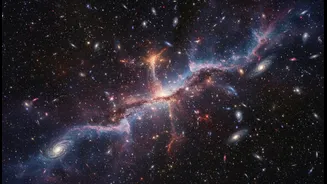
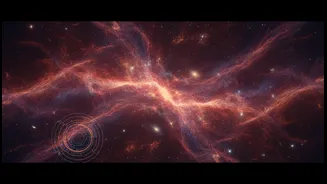
The process of colouring these images is often called “false-colour” imaging, but that doesn’t mean the information is fake. It’s a method of data visualisation. Scientists assign specific colours—typically red, green, and blue—to different wavelengths of light that were captured. Often, the longest wavelength is assigned red, the shortest blue, and a medium one green. This allows them to map different physical properties. For example, in many JWST images, blue can indicate areas with thinner dust or the presence of very hot, young stars. Hues of orange and red often represent thicker layers of dust and molecular hydrogen, the primary fuel for star formation. By assigning colours to elements like hydrogen, oxygen, and sulphur, astronomers can distinguish the chemical makeup and temperature of different parts of a nebula, turning a black-and-white data set into a rich, informative tapestry.
Anatomy of a Stellar Nursery
Let’s look at the famous Pillars of Creation, a small region within the Eagle Nebula. In JWST's near-infrared view, the once-opaque brown pillars become more transparent, revealing countless young stars as bright red orbs. These newly formed stars are often still wrapped in a dusty cocoon, which makes them shine brightly in infrared light. Along the edges of the pillars, you can see wavy, lava-like features. These are energetic jets of material being shot out from stars that are still forming. The crimson glow in these areas often comes from energised hydrogen molecules, shocked by these powerful outflows. The different colours allow scientists to see the direct interaction between the newborn stars and their environment, watching as their intense radiation slowly erodes the very pillars of gas and dust from which they were born.
From Cosmic Cloud to Fusion Fire
Star formation begins when a dense clump within a giant molecular cloud collapses under its own gravity. This initial stage creates a protostar—a hot, dense core that is still gathering mass from a surrounding disk of gas and dust, known as an accretion disk. This phase, lasting around 500,000 years for a Sun-like star, is where these colourful images are most revealing. The protostar itself doesn't yet shine from nuclear fusion like a mature star; its light comes from the heat generated by its gravitational contraction and the material falling onto it. It glows intensely in infrared light, often hidden from visible-light telescopes. As the protostar continues to pull in material, its core becomes hotter and denser. Eventually, the temperature and pressure reach a critical point—about 10 million Kelvin—igniting nuclear fusion. At this moment, a true star is born, and it begins to shine, clearing away the remaining gas and dust with its stellar winds and radiation.