





The race to build data centers in space is heating up, with companies promising to revolutionize AI by processing data directly in orbit. But on the ground, astronomers are sounding the alarm, warning of a catastrophic impact on our view of the cosmos.
What Are Orbital Data Centers?
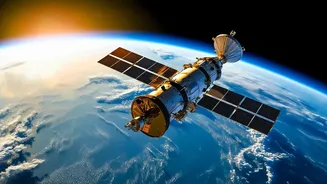
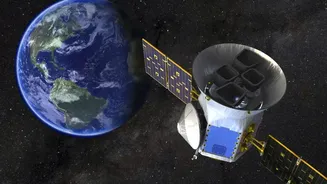
Imagine a server farm, not in a vast warehouse in Virginia or Texas, but orbiting the Earth at thousands of miles per hour. This is the concept of orbital computing. The goal is to co-locate data processing with the satellites that collect the data. Companies like SpaceX, Starcloud, and Google are developing plans to place powerful computing hardware, including advanced AI chips from manufacturers like Nvidia, into low-Earth orbit. The primary advantage is speed. Earth-observation satellites generate enormous amounts of data, and beaming it all to the ground for processing creates a significant time lag. By processing the data in space, only the most crucial insights need to be sent down, cutting latency from hours to minutes. This has major implications for applications like tracking natural disasters, monitoring supply chains, or military reconnaissance. Some companies envision constellations with tens of thousands, or in SpaceX's case, up to one million, of these 'data center satellites'.
A New Window to the Universe
Meanwhile, in the Atacama Desert of Chile, the Vera C. Rubin Observatory is preparing to begin its own revolutionary mission. Its centerpiece is the Legacy Survey of Space and Time (LSST), a ten-year project to image the entire southern sky every few nights. This survey will generate an unprecedented movie of the cosmos, helping scientists tackle some of the biggest questions in physics, such as the nature of dark matter and dark energy. It will also map the Milky Way in stunning detail and create a vast catalog of asteroids and other moving objects, some of which could be potentially hazardous to Earth. The observatory's power lies in its ability to detect incredibly faint and fast-changing objects over a huge field of view, something no other telescope can do on this scale.
A Collision Course in the Sky
The goals of orbital computing and the Rubin Observatory are fundamentally at odds. The problem is light pollution, but not from cities. Satellites in low-Earth orbit reflect sunlight, and as they cross a telescope's field of view, they leave bright streaks in the images. This contamination can saturate a telescope's sensitive detectors, effectively ruining the data in that portion of the image. For an observatory like Rubin, which will take rapid, wide-field images, the problem is magnified. Even before the proposed orbital data centers, simulations showed that existing satellite constellations could contaminate up to 30% of Rubin's images taken during the critical twilight hours. These streaks can be mistaken for real astronomical events like supernovae, and even when they are identified and masked, they result in a loss of valuable scientific data.
An Unprecedented Level of Interference
The planned expansion of orbital data centers takes this threat to an entirely new level. Recent studies simulating the impact of a million-strong satellite constellation are stark. One paper published in October 2026 found that on a given night, up to 80% of Rubin's images could be contaminated by a satellite streak. Furthermore, the collective brightness of so many satellites would dramatically increase the overall brightness of the night sky, potentially by more than 1000% during twilight. This would effectively be like trying to do delicate scientific observations under a permanent, faint aurora, washing out the faint galaxies and stars the observatory was built to discover. Scientists warn that launching these systems at the proposed scale would 'significantly harm' the science goals of the LSST, with nightly pixel losses of 5–10% even if some mitigation measures are taken.
Is There a Path to Compromise?
Astronomers and some satellite operators are actively seeking solutions, though none are perfect. Strategies include painting satellites with darker, less reflective materials, designing them to orient their shiny surfaces (like solar panels) away from Earth, and keeping them in lower orbits (below 600 kilometers) so they spend more of the night in Earth's shadow. Software is also being developed to better predict satellite paths so telescopes can try to 'dodge' the brightest objects, and to more effectively remove the streaks from images during data processing. However, these are only partial fixes. A recent workshop concluded that no combination of mitigations, short of launching far fewer satellites, can completely eliminate the problem. The sheer number of proposed orbital data centers threatens to overwhelm these efforts, creating a future where the sky is permanently crisscrossed by a web of artificial stars.