



The Old Engineering Challenge
For decades, high school students interested in engineering have faced a common hurdle: the gap between theory and practice. Learning about thermodynamics, fluid dynamics, or complex circuitry from a book is one thing; truly understanding how these principles
apply in the real world is another. Access to advanced labs, expensive machinery, or potentially hazardous materials is limited, making hands-on learning a challenge. This often leaves complex concepts feeling abstract and disconnected from the exciting reality of building and creating, a problem that educators have long sought to solve.
Enter the Immersive Classroom
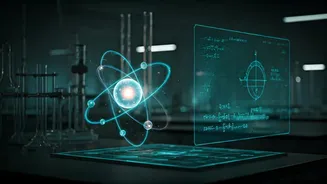
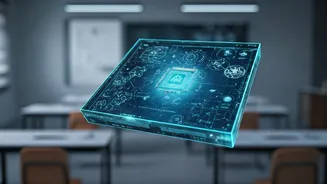
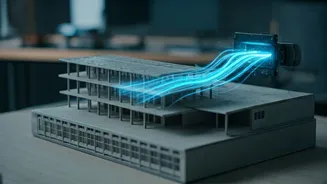
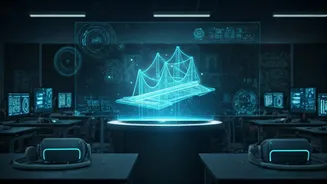
The upgrade comes in the form of AI-powered Virtual Reality (VR) classrooms. Imagine students putting on a VR headset and being instantly transported not to a video game, but to a fully functional, true-to-scale digital replica of a factory floor, a jet engine, or a sophisticated chemical lab. This is the concept of the 'digital twin' classroom. Here, they can walk around, interact with machinery, and conduct experiments without physical limitations or safety risks. It's a hands-on experience on an epic scale, allowing them to see, touch, and manipulate concepts that were previously confined to two-dimensional diagrams.
AI as the Personal Tutor
The VR environment is only half of the equation. The real magic happens when Artificial Intelligence is integrated. The AI acts as a personal, on-demand tutor for every student in the virtual space. As a student attempts to assemble a virtual engine, the AI can provide real-time feedback, highlighting mistakes and suggesting corrections. It can adapt the difficulty of a task based on the student's performance, ensuring they are always challenged but never overwhelmed. It can answer questions instantly, providing data, schematics, or theoretical explanations on the fly. This turns a passive viewing experience into an active, guided learning journey.
Learning by (Virtual) Doing
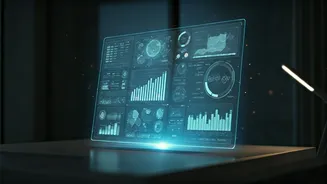
The benefits are profound. Students can learn by trial and error in a way that would be impossible, dangerous, or prohibitively expensive in the real world. Want to see what happens when you apply too much pressure to a hydraulic press? Go ahead. Curious about the internal combustion process? Shrink down and stand inside the cylinder as it fires. This type of experiential learning fosters a much deeper and more intuitive understanding of core engineering principles. It also builds crucial skills for the modern workplace, where engineers regularly use advanced simulation software to design and test products before a single physical component is built.
The Road Ahead in India
While not yet standard in every school, this technology is no longer science fiction. Several global tech companies are partnering with educational institutions to roll out pilot programs. In India, where initiatives like the National Education Policy (NEP) 2020 strongly advocate for experiential and technology-led learning, AI/VR classrooms are a natural fit. They have the potential to democratise access to high-quality technical education, giving students in remote areas the same lab experiences as those in metropolitan hubs. Of course, challenges remain. The cost of hardware, the need for robust internet infrastructure, and the necessity of training teachers to be effective guides in these new digital worlds are significant hurdles. But the momentum is building.