



A 'New Star' in the Heavens
In the autumn of 1604, sky-watchers across Europe, China, and Korea noticed an impossibly bright object in the constellation Ophiuchus. At its peak, it outshone Jupiter and was visible even in daylight for over three weeks. The event captured the attention
of German astronomer Johannes Kepler, who meticulously documented it for over a year. At the time, the prevailing belief, held since antiquity, was that the heavens beyond the Moon were perfect and unchanging. This 'stella nova', or new star, presented a direct challenge to that idea. Kepler and his contemporaries were witnessing a profound change in the cosmos, but they didn't know they were watching a star die.
Kepler's Star: A Cosmic Demise
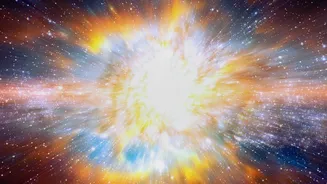
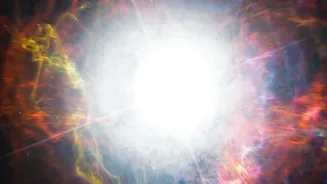
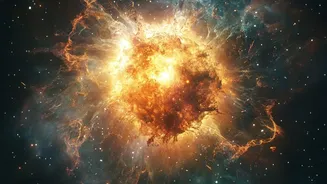
Centuries later, modern astronomy revealed the truth: Kepler hadn't seen a birth, but a spectacular death. The event, now known as SN 1604 or Kepler's Supernova, was the colossal explosion of a star. It is the most recent supernova to have been definitively observed with the naked eye within our own Milky Way galaxy. Specifically, it was a Type Ia supernova. This type of explosion happens in a binary star system, where two stars orbit each other. It involves a white dwarf—the dense, hot core left over from a sun-like star that has exhausted its fuel.
What Is a Supernova?
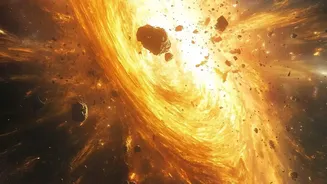
A supernova is one of the largest explosions the universe has to offer. There are two main paths to such a cataclysm. The first, a 'core-collapse' supernova, is the fate of a single, massive star at least eight times the size of our Sun. When it runs out of fuel, gravity wins the lifelong battle against the star's internal pressure, causing it to collapse and then violently rebound in a massive explosion. The second path is a Type Ia supernova, like Kepler's. This occurs when a white dwarf in a binary system pulls too much matter from its companion star, or merges with another white dwarf. This added mass pushes the white dwarf over a critical limit, triggering a runaway thermonuclear explosion that completely obliterates it.
Supernova vs. Nova: A Common Confusion
The term 'nova,' Latin for 'new,' historically referred to any new light in the sky. Today, we distinguish between a supernova and a nova. A nova is also a stellar explosion in a binary system involving a white dwarf, but it's a much smaller affair. In a nova, the material pulled from the companion star ignites in a burst of nuclear fusion on the white dwarf's surface. This causes a sudden, intense brightening, but it's a surface-level event. The white dwarf itself survives and the process can repeat. A supernova, by contrast, is a terminal event that destroys the star and is millions of times brighter.
The Birth of a Real New Star
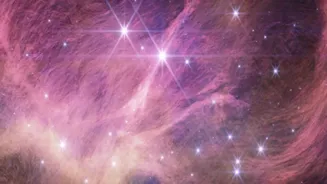
So if supernovae and novae are explosions of existing stars, how is a truly 'new' star born? Star birth is a far gentler, slower process. It begins inside vast, cold clouds of gas and dust called nebulae. Gravity pulls clumps of this material together. Over millions of years, these clumps grow denser and hotter, forming a protostar. When the core becomes hot and dense enough to ignite nuclear fusion—the same process that powers our Sun—a new star is officially born. This process is one of creation, the opposite of the destructive force of a supernova. In fact, the material ejected by supernovae enriches space with heavy elements, providing the raw materials for the next generation of stars and planets.
Death Becomes Life
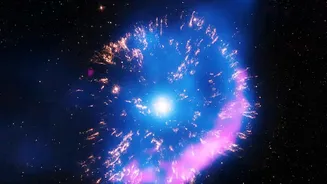
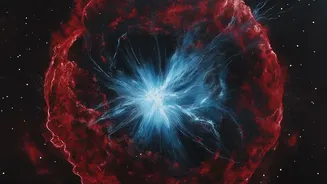
The key difference is simple: a supernova is the explosive death of a star, while the formation of a 'new star' is its birth from a cosmic cloud. While a nova is a temporary flare-up, a supernova is a final, galaxy-outshining farewell. The 1604 event was a pivotal moment. By providing evidence that the heavens could change, it helped astronomers like Kepler lay the groundwork for a new understanding of the universe—one that was dynamic and evolving. Today, the expanding cloud of debris from Kepler's star, known as a supernova remnant, is still studied by telescopes, offering clues about the explosion that lit up the sky over 400 years ago.