




Why Europa? The Allure of a Hidden Ocean
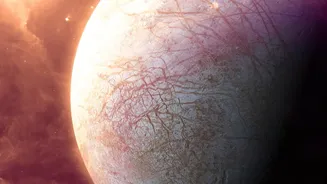
For decades, scientists have been captivated by Jupiter's moon Europa. Strong evidence suggests that beneath its icy crust, which could be anywhere from 3 to 30 kilometres thick, lies a global ocean of liquid saltwater. In fact, this hidden ocean may
contain more than twice the volume of all of Earth's oceans combined. On our planet, wherever we find water, we find life. This makes Europa one of the most compelling targets in the search for habitable environments beyond Earth. The evidence for this ocean comes from multiple sources. Data from the Galileo spacecraft in the 1990s revealed a distorted magnetic field around Europa, which strongly implies the presence of a conductive material like a salty ocean. The moon's fractured, chaotic surface also suggests a dynamic, mobile layer of liquid water flowing beneath the frozen shell.
Meet the Clipper: A Journey of Billions of Kilometres
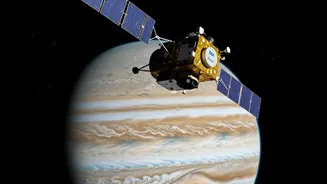
To investigate this tantalising world, NASA designed and launched the Europa Clipper, the largest interplanetary spacecraft the agency has ever built. Having launched on a SpaceX Falcon Heavy rocket on October 14, 2024, the probe is currently on a long and complex journey to the Jupiter system. Instead of flying straight there, the mission is using a series of clever gravity assists to build up speed. It flew past Mars in March 2025 and is scheduled for a final slingshot past Earth in December 2026. This intricate flight path will allow it to arrive in Jupiter's orbit by April 2030. Once there, it won't orbit Europa directly due to the planet's intense and damaging radiation belts. Instead, it will orbit Jupiter and perform approximately 49 close flybys of Europa, some as low as 25 kilometres above the surface, to gather detailed measurements.
A Toolkit to Hunt for Habitability
Europa Clipper isn't a life-detection mission; its primary goal is to determine if Europa has the right conditions to support life. To do this, it carries a sophisticated suite of nine scientific instruments. An ice-penetrating radar called REASON will probe the ice shell to measure its thickness and search for pockets of water within it. A magnetometer will confirm the ocean's existence and help determine its depth and salinity. Spectrometers will analyse the chemical composition of the surface, looking for salts and organic compounds that might have seeped up from the ocean below. The spacecraft will even carry a dust analyser that can sample any particles ejected into space, perhaps from plumes of water erupting through the ice. Together, these instruments will paint the most detailed picture yet of this mysterious ocean world.
What Would Finding the Ingredients for Life Mean?
Confirming that Europa is habitable would be a monumental discovery in human history. It would mean that the ingredients for life—liquid water, essential chemical elements, and a source of energy, likely from tidal flexing and potential seafloor vents—exist elsewhere in our own solar system. While Clipper cannot find direct evidence of living organisms, its findings will guide future missions that could one day land on the surface and even deploy a submersible to explore the alien ocean directly. The mission will help scientists understand the potential for life to arise in similar ocean worlds across our galaxy. The data gathered between its arrival in 2030 and the planned end of its prime mission in 2034 will keep scientists busy for years, fundamentally changing our understanding of our place in the cosmos.