





A Glimpse into a 'Steam World'
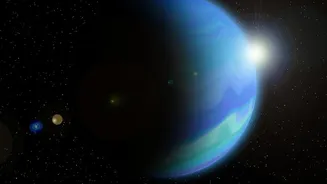
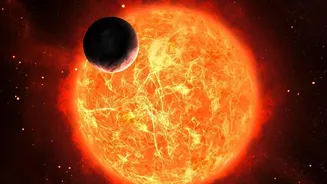
Scientists have confirmed the presence of a water-rich atmosphere around an exoplanet known as GJ 9827 d, located nearly 100 light-years from Earth. This isn't just a faint hint of moisture; the atmosphere appears to be significantly composed of water vapor,
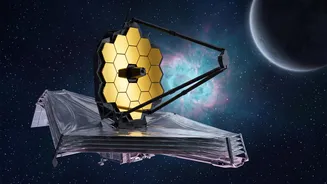
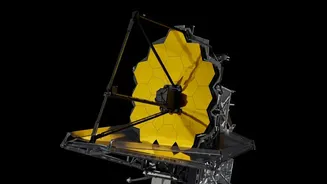
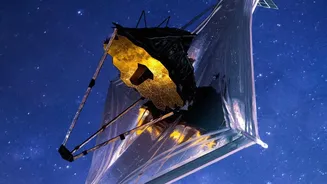
leading some researchers to dub it a 'steam world'. The discovery is a monumental achievement for the James Webb Space Telescope, showcasing its unprecedented ability to probe the chemical makeup of planets far beyond our solar system. The find is particularly exciting because, at only about twice the diameter of Earth, GJ 9827 d is the smallest exoplanet to date where water has been so clearly identified in the atmosphere, a milestone that was previously limited to much larger gas giants.
The Target: A Hot and Steamy Planet
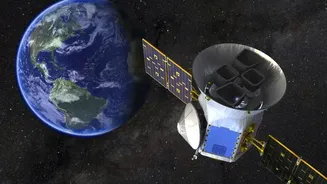
GJ 9827 d is not a potential vacation spot. It orbits its star at a very close distance, completing a full year in just over six Earth days. This proximity results in scorching surface temperatures estimated to be around 425 degrees Celsius, similar to the planet Venus. At this temperature, any water would exist as steam, creating a dense, humid, and entirely inhospitable atmosphere for life as we know it. Discovered in 2017 by the Kepler space telescope, the planet's relatively low density had long suggested it might contain a significant amount of water. While initial hints of water were found by the Hubble Space Telescope, it took the advanced infrared capabilities of the JWST to confirm the atmosphere is not hydrogen-dominated but rich in heavier molecules like water.
How Webb Decodes Distant Atmospheres
Detecting elements from 97 light-years away is a remarkable technological feat. Astronomers used a technique called transmission spectroscopy. As GJ 9827 d passed in front of its host star, the JWST's instruments, including the Near-Infrared Imager and Slitless Spectrograph (NIRISS), carefully analyzed the starlight that filtered through the planet's atmosphere. Different molecules absorb specific wavelengths, or colours, of light. Water vapor leaves a distinct chemical fingerprint on the light's spectrum, which the telescope is sensitive enough to detect. This method allows scientists to effectively 'read' the atmospheric composition of a world they can never visit, distinguishing between a hydrogen-based atmosphere, like Neptune's, and a heavier, water-rich one.
Why This Finding Is a Game-Changer
While GJ 9827 d itself is not habitable, its discovery is a critical proof of concept for astronomers. It demonstrates that the technology is now mature enough to detect and analyze atmospheres around smaller, potentially rocky planets. For years, such detailed atmospheric studies were only possible for massive 'hot Jupiters'. Finding a water-rich atmosphere on a planet only twice Earth's size is a huge leap towards the ultimate goal: analyzing the atmospheres of Earth-sized planets located in the habitable zone — the region around a star where liquid water could exist on a planet's surface. This discovery gives scientists confidence that if an Earth 2.0 exists, the JWST has the tools to find its atmospheric biosignatures.