


A Day Versus a Year, Venus-Style
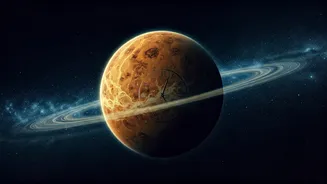
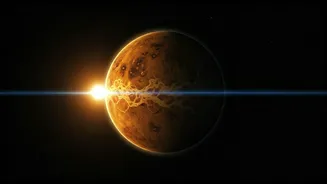
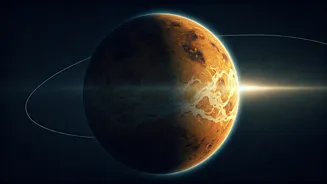
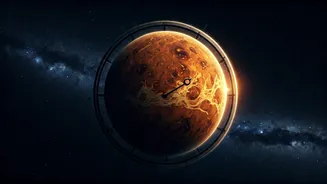
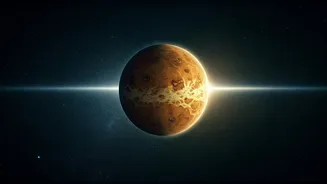
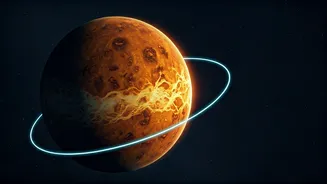
On Earth, our sense of time is simple: a day is one rotation of our planet (24 hours), and a year is one orbit around the Sun (365 days). On Venus, this fundamental logic is turned on its head. A Venusian year, the time it takes to complete one full orbit around the Sun,
is about 225 Earth days. This is where it gets strange. A Venusian day, the time it takes for the planet to complete a single rotation on its axis, is approximately 243 Earth days. That’s right—it takes longer for Venus to spin once than it does for it to travel all the way around the Sun. If you could stand on Venus, you would celebrate your first ‘new year’ before you even experienced a single full ‘day’.
The Solar System's Slowest Spin
So, why is Venus such a cosmic slowpoke? It has the slowest rotation of any major planet in our solar system. The reasons are not fully understood, but scientists have several compelling theories. One leading idea is that Venus’s incredibly thick, heavy atmosphere—over 90 times denser than Earth's—creates a powerful atmospheric drag. This dense blanket of gas could be exerting a braking force on the planet's surface, slowing its spin over billions of years. Another theory points to its past. It’s possible that a massive collision with another large celestial body in the early solar system knocked Venus off-kilter, drastically altering its rotational speed and even direction. Which brings us to another oddity: Venus spins backwards. Unlike most other planets, including Earth, it rotates from east to west, a phenomenon known as retrograde rotation. On Venus, the Sun would rise in the west and set in the east.
Sunrise, Sunset, and a Very Long Wait
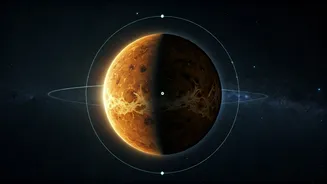
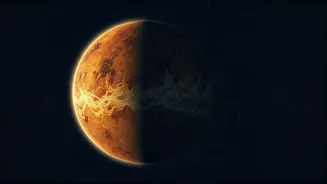
The combination of its slow, backward spin and its orbit creates another mind-bending effect related to its ‘solar day’—the time from one sunrise to the next. While a single rotation (a sidereal day) takes 243 Earth days, a solar day on Venus is significantly shorter, at about 117 Earth days. Why? Because as the planet slowly spins backward, it is also moving forward in its orbit around the Sun. This motion means a spot on the surface doesn't have to complete a full 360-degree turn to see the Sun in the same position again. For a hypothetical resident, this would mean roughly 58 days of continuous daylight followed by 58 days of continuous night. Imagine watching a sunrise that takes months to become a sunset—it’s a timescale that completely warps our Earthly understanding of day and night.
Earth's 'Evil Twin'
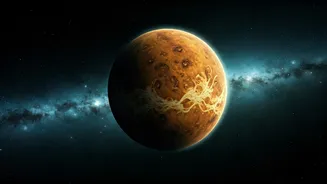
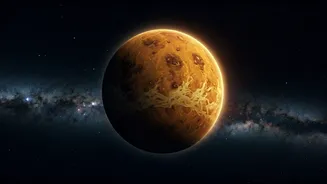
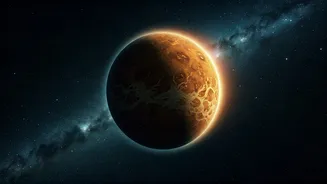
This bizarre timing is just one reason Venus is often called Earth’s ‘evil twin.’ While similar in size and mass to our own planet, Venus is one of the most inhospitable places imaginable. Its thick atmosphere, composed mainly of carbon dioxide, has created a runaway greenhouse effect. Surface temperatures hover around a scorching 465°C, hot enough to melt lead. The atmospheric pressure at the surface is equivalent to being nearly a kilometre deep in Earth’s oceans—an instantly crushing force for any human or spacecraft not specifically designed to withstand it. Clouds of sulfuric acid drift through its upper atmosphere. It’s a toxic, high-pressure oven of a planet, a stark warning of what can happen when a planet's climate goes catastrophically wrong.
Why This Cosmic Oddity Matters
Studying Venus and its peculiarities isn't just about collecting trivia. Understanding why Venus evolved so differently from Earth is crucial for planetary science. By comparing these two ‘twin’ planets—one a habitable paradise and the other a hellscape—we can learn more about the factors that make a planet liveable. The slow rotation, the thick atmosphere, and the runaway greenhouse effect are all pieces of a puzzle. Solving it helps us understand not only the history of our own solar system but also what to look for when searching for habitable exoplanets orbiting distant stars. Venus serves as a natural laboratory for studying planetary extremes, providing invaluable lessons about climate, geology, and the delicate balance that allows life to thrive.