



The Heavy Burden of Chemical Rockets
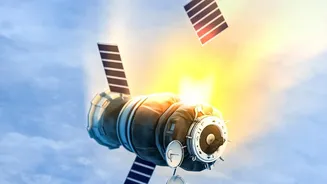
Traditionally, satellites have relied on chemical propulsion. Think of it like a controlled explosion: a liquid fuel and an oxidiser are mixed and ignited, producing a powerful burst of thrust. This method is great for getting a heavy rocket off the ground,
but it’s incredibly inefficient for the delicate manoeuvres a satellite needs to perform in space. A large communication satellite might need to carry thousands of kilograms of chemical propellant just for orbit adjustments and station-keeping throughout its 12-to-15-year lifespan. This propellant is dead weight, taking up valuable mass that could otherwise be used for scientific instruments or communication hardware. It's a fundamental limitation that makes satellites heavy, expensive to launch, and constrains their operational life.
A New Push: What is Electric Propulsion?
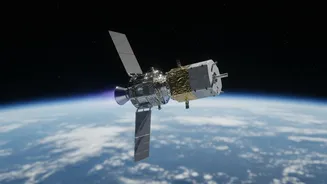
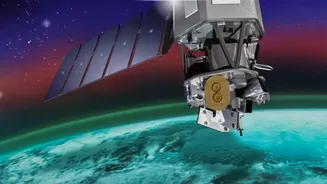
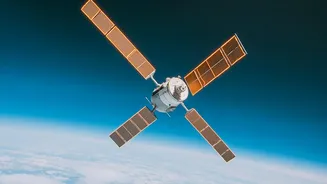
Electric propulsion (EP) flips the script entirely. Instead of using the brute force of chemical reactions, EP systems use electrical power, typically generated by the satellite's solar panels, to accelerate a propellant. The propellant is usually an inert gas, like xenon. These systems don't produce the powerful roar of a chemical rocket; in fact, the thrust is incredibly gentle, often compared to the force of a single piece of paper resting on your hand. But what they lack in raw power, they make up for with extraordinary efficiency. This trade-off is at the heart of why EP is revolutionising satellite design and space exploration. It's a marathon runner compared to a chemical rocket's sprint.
Trading Brute Force for High Efficiency
So how does it work? There are a few types of electric thrusters, but two common ones are ion thrusters and Hall thrusters. Both operate on a similar principle. First, the xenon gas is ionised, meaning its atoms are given an electrical charge. Then, powerful electric or magnetic fields are used to accelerate these charged ions to extremely high speeds—far faster than the exhaust from a chemical rocket—and shoot them out of the thruster. According to Newton's third law, for every action, there is an equal and opposite reaction. Pushing these tiny ions out at incredible velocity creates a small but continuous push in the opposite direction, propelling the satellite forward. This method is exceptionally efficient, with a 'specific impulse' (the measure of a rocket's efficiency) that can be five to six times higher than that of chemical systems.
Lighter Loads and Longer Missions
The benefits of this efficiency are immense. A satellite that once needed thousands of kilograms of chemical fuel might now need only a couple of hundred kilograms of xenon gas to perform the same job. This drastic weight reduction has a cascading effect. A lighter satellite can be launched on a smaller, cheaper rocket. Alternatively, the weight saved on fuel can be reallocated to the payload, meaning a satellite of the same size can carry more transponders, more powerful sensors, or more scientific instruments, enhancing its mission capabilities. Furthermore, because the propellant is used so sparingly, the satellite's operational lifespan can be significantly extended, allowing it to perform orbital corrections for many more years.
ISRO's Journey to Electric Dreams
ISRO has been strategically moving towards mastering this technology. While an early version was tested on the GSAT-9 satellite in 2017 using some imported components, the space agency is now developing fully indigenous electric propulsion systems. Recent successful endurance tests of a new, more powerful Stationary Plasma Thruster show significant progress. Satellites like the upcoming Technology Demonstrator Satellite (TDS-01) are designed to prove these homegrown systems in the harsh environment of space. The goal is to eventually have all-electric satellites, from communication giants like the planned GSAT-20, which will be significantly lighter thanks to EP, to future spacecraft destined for interplanetary missions where the high efficiency of electric thrusters is critical for long-duration journeys beyond Earth's orbit.