







The Great Monsoon Myth: If It's Cloudy, You're Covered
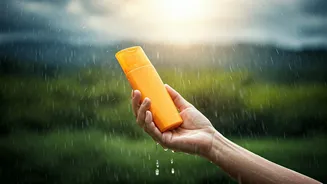
The most common misconception about monsoon skincare is that cloudy skies offer enough protection from the sun. [19] This belief leads many to skip sunscreen, assuming the lack of direct sunlight means their skin is safe. People often associate sun damage
with the heat and brightness of a sunny day. [20] When the weather is cool, humid, and overcast, applying a layer of SPF can feel unnecessary or even uncomfortable. [19, 21] However, what you can't see can still harm your skin. The cool temperatures and grey skies create a false sense of security, leading to weeks or even months of unnoticed UV damage. [8]
The Unseen Danger: How UV Rays Penetrate Clouds
Here's the scientific reality: clouds do not block all harmful ultraviolet (UV) radiation. Studies show that up to 80% of the sun's UV rays can penetrate through cloud cover. [2, 7, 12] There are two main types of UV rays that damage skin: UVB, which causes sunburn, and UVA, which leads to premature ageing and deeper skin damage. [22] While clouds can reduce the intensity of UVB rays, they have much less effect on UVA rays, which make up about 95% of the UV radiation reaching Earth. [20, 22] These longer-wavelength UVA rays are present all day, year-round, and can even penetrate glass, meaning your skin is exposed even while indoors near a window or driving. [3, 8, 25]
Why Your Skin is Still at Risk
Cumulative exposure to UVA rays, even at low levels on cloudy days, is a major contributor to long-term skin issues. This includes photoaging, which appears as fine lines, wrinkles, and sagging skin. [15] It also triggers and worsens hyperpigmentation, leading to dark spots and an uneven skin tone. [23] In India, where darker skin tones are common, sun damage may not always show up as a red burn, but rather as stubborn pigmentation and tanning that becomes more apparent months later. [8, 23] Furthermore, all UV exposure contributes to DNA damage, increasing the risk of skin cancer over your lifetime. [15, 20]
Choosing Your Monsoon Armour: The Right Sunscreen
The key to protecting your skin during the monsoon is choosing a sunscreen that works with the humid, rainy weather, not against it. Heavy creams that felt fine in winter can feel sticky and occlusive when humidity is high. [16] For the Indian monsoon, dermatologists recommend a broad-spectrum sunscreen with an SPF of 30 or higher, with SPF 50 being an even better choice for robust protection. [21, 24] Look for formulas that are labelled "water-resistant," as they are designed to withstand sweat and moisture better. [3, 24] Lightweight, non-greasy textures like gel-based sunscreens are ideal for oily and acne-prone skin, as they absorb quickly without clogging pores. [14, 18]
Application is Everything: Making it a Habit
Choosing the right product is only half the battle. Correct application is crucial for effective protection. Even on a rainy day, sunscreen should be applied as the last step of your skincare routine, about 15-30 minutes before you head out. [23, 24] A common guideline for the face and neck is the "two-finger rule"—squeezing a line of sunscreen along your index and middle fingers. [24] Since humidity, sweat, and rain can cause sunscreen to wear off, reapplication every two to three hours is non-negotiable, especially if you've been outdoors or have been sweating. [7, 21] For reapplication over makeup, a spray or powder SPF can be a convenient option. [14]