




The Hostile Frontier Below
Imagine an environment where the pressure is hundreds of times greater than at the surface, temperatures are near freezing, and there is absolutely no sunlight. This is the everyday reality of the deep sea. These extreme conditions make exploration incredibly
difficult and dangerous. Any equipment sent to these depths must be able to withstand forces that would instantly crush a conventional submarine. Furthermore, the life that exists here has developed unique adaptations to survive. Understanding this alien world requires more than just getting there; it requires the ability to observe, interact, and collect data in a place fundamentally inhospitable to humans. This is where the partnership between engineering and biology becomes not just helpful, but absolutely essential.
The Engineering Powerhouse
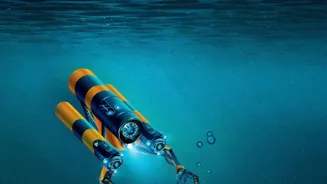
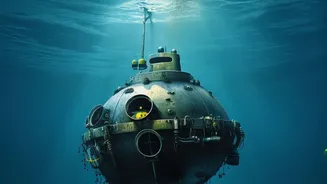
Engineers are the architects of access to the deep. Their primary role is to design and build the tools that bridge the gap between our world and the abyss. This includes sophisticated remotely operated vehicles (ROVs) and autonomous underwater vehicles (AUVs), which act as the eyes, hands, and ears of the scientists on the ship above. These are not simple drones; they are complex robotic systems built to endure immense pressure and corrosive saltwater. Mechanical engineers focus on structural integrity, ensuring the vehicle doesn't implode. Electrical and software engineers design the 'nervous system'—the power distribution, sensor arrays, high-definition cameras, and the miles-long fiber-optic tethers that send commands and receive live video from the seafloor. The goal is to create a reliable platform that can perform delicate tasks, like manipulating a robotic arm to collect a rock sample or a fragile marine organism, thousands of metres below the surface.
The Biological Detectives
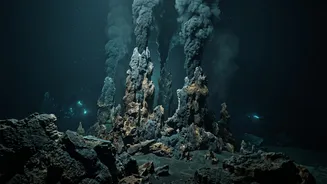
While engineers build the 'how', biologists provide the 'why'. Their focus is on the life and ecosystems hidden in the darkness. Aboard a research vessel, biologists guide the ROV pilots, using the live video feed to identify areas of interest. They might be searching for new species, studying the behaviour of known creatures, or mapping the extent of a deep-sea coral garden. Their expertise is crucial for interpreting what the cameras see. They can spot a never-before-seen octopus, identify a field of hydrothermal vents teeming with life, or direct the collection of water samples to analyze for environmental DNA (eDNA), a technique that reveals what species are present without ever seeing them. They are responsible for designing the scientific mission and making sense of the data and samples brought back to the surface.
Synergy in Action
The true magic happens in the control room of a research ship, a high-tech space where these two teams merge. Picture this: a biologist spots a delicate, gelatinous creature floating in the mid-water, potentially a new species. Simply collecting it with a net would destroy it. The biologist communicates the scientific need to the engineering team. An engineer then skillfully pilots the ROV, using its manipulator arms equipped with specially designed, gentle samplers—perhaps an 'origami-inspired' device that folds around the animal—to carefully secure it. During this process, another engineer ensures the vehicle's systems are stable and that all sensor data is being recorded correctly. This seamless collaboration—the biologist's scientific goal enabled by the engineer's technical execution—is what makes modern deep-sea discovery possible. It's a real-time partnership between human and machine, scientist and operator.
Pushing the Boundaries of Discovery
This interdisciplinary approach is pushing the frontiers of what we know about our own planet. Organisations like the Woods Hole Oceanographic Institution (WHOI) and the Schmidt Ocean Institute are built on this model of collaboration between scientists and engineers. The discoveries are astounding, from identifying what might be the world's longest animal to finding new ecosystems that thrive without sunlight. This teamwork also fuels innovation. Biologists' need to study fragile organisms at in situ pressure has led engineers to develop new pressurised sample handlers and advanced imaging systems. As we look to the ocean for answers to some of humanity's biggest challenges, from climate change to new medicines, the combined expertise of those who can build the tools and those who can understand the life they reveal will be more critical than ever.