




The Constant Drag on Modern Satellites
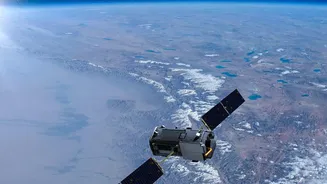
Satellites in low-Earth orbit (LEO), which is generally the region up to 2,000 kilometres above Earth, are fundamental to our modern infrastructure. They enable global communications, provide vital Earth observation data, and support navigation systems.
However, even at these high altitudes, the atmosphere isn't a perfect vacuum. Trace amounts of atmospheric particles create a persistent drag on satellites, especially in very-low Earth orbits (VLEO) below 400-450 km. This friction, though minuscule, causes a satellite's orbit to gradually decay. Over time, it loses altitude and speed, eventually forcing it to re-enter the atmosphere and burn up. To counteract this, satellites must carry their own propellant and periodically fire thrusters to boost themselves back into a stable orbit, a process known as station-keeping.
The Tyranny of the Fuel Tank
The need to carry propellant is a satellite's greatest limitation. The amount of fuel onboard dictates its operational lifespan; once the fuel runs out, the mission is effectively over. This is a significant economic constraint. More fuel means a heavier satellite, which in turn means a more expensive launch. For missions in VLEO, where atmospheric drag is much stronger, the fuel requirements are even more demanding, making long-duration missions impractical or impossible. Satellites operating below 300 km can be very short-lived without constant propulsion support. This has largely kept operators in higher, less-drag-intensive orbits, sacrificing the benefits of being closer to Earth, such as higher-resolution imaging and lower latency communications.
A Breakthrough: Inhaling the Atmosphere
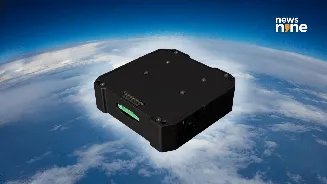
Imagine a jet engine, but for space. That is the core idea behind Air-Breathing Electric Propulsion (ABEP), also known as Atmosphere-Breathing Electric Propulsion. Instead of carrying heavy tanks of propellant like xenon gas, an ABEP system is designed to scoop up the sparse atmospheric molecules it encounters in low orbit. These collected particles—the very same ones that cause drag—are then used as the propellant. The system channels the captured air into a thruster, where the gas is ionised (given an electric charge) and then electromagnetically accelerated at high velocity. This creates thrust, pushing the satellite forward and directly counteracting the atmospheric drag. The concept essentially turns a satellite's biggest problem into its fuel source.
The Revolutionary Implications
The ability to generate thrust without onboard propellant is a paradigm shift. An ABEP-equipped satellite could theoretically operate indefinitely, its mission life limited only by the durability of its electronic components, not its fuel supply. This would dramatically increase the return on investment for commercial satellite operators. It opens up VLEO for long-term missions, enabling a new class of satellites with sharper Earth observation capabilities and faster communication links. Furthermore, this technology promotes space sustainability. Satellites could stay in these lower orbits where space debris naturally deorbits faster, helping to mitigate the growing problem of orbital junk. Multiple organisations, including the European Space Agency (ESA) and US-based companies like Phase Four under contract with DARPA, are actively developing and testing these systems, signalling a major push towards making this technology a reality.
The Road to an Unlimited Orbit
While the concept is revolutionary, significant engineering challenges remain. Designing an intake that can efficiently collect enough of the incredibly rarefied air at orbital speeds (around 8 km/s) is a complex task. The thruster must also be robust enough to handle a mix of atmospheric gases, primarily atomic oxygen, which can be highly corrosive. However, progress is accelerating. ESA announced the successful ground test of a prototype in 2018, and several research groups and companies are refining their designs. For instance, DARPA's Otter program aims to culminate in an on-orbit demonstration to prove the technology's viability in the actual space environment. Ahmedabad-based startup Orbitt Space is also developing its own air-breathing engine, highlighting global interest in this technology.