

The Power Problem on the Moon
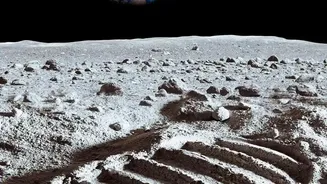
Powering a lunar outpost is uniquely difficult due to the Moon's brutal day-night cycle. A single lunar night lasts for about 14 Earth days, plunging temperatures to below -170°C. During this extended, deep-freeze darkness, solar panels are rendered useless,
and any base must survive on stored energy or find an alternative source to run life support, communications, and scientific equipment. Furthermore, the Moon lacks an atmosphere, which means there's no weather to disrupt sunlight during the day, but it also provides no protection from extreme temperature swings and abrasive lunar dust, which can cover panels and reduce their efficiency. Solving this energy gap is the critical first step to making long-term habitation a reality.
The Solar Solution: Catching Rays at the Poles
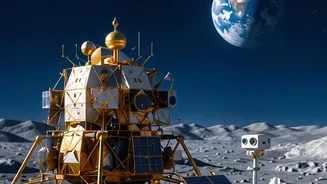
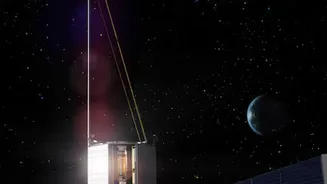
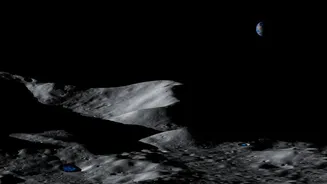
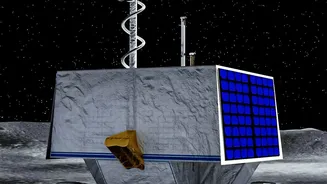
Solar power will be a cornerstone of early lunar missions. The key is strategic location. NASA and other agencies plan to build bases near the Moon's South Pole, where some elevated crater rims and peaks receive near-continuous sunlight. These 'peaks of eternal light' dramatically reduce the long periods of darkness, making solar power much more reliable. However, even here, shadows can be long and persistent. To overcome this, companies like Blue Origin are developing innovative vertical solar arrays, such as a 20-metre-tall 'Power Tower'. This system raises solar panels high above the surface to catch the sun's rays as it skims the horizon, providing near-continuous power. Still, for industrial-scale activities like mining for water ice in permanently shadowed craters, solar power alone isn't enough.
The Nuclear Option: Constant Power, Day or Night
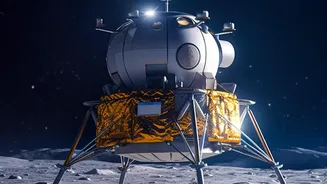
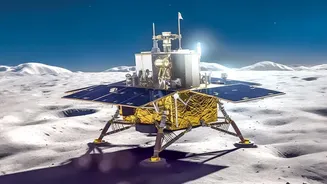
To guarantee an uninterrupted power supply, especially during the two-week lunar night, space agencies are turning to nuclear fission. NASA's Fission Surface Power project is working with partners to develop compact, lightweight nuclear reactors designed specifically for the lunar surface. These are not like the sprawling nuclear power plants on Earth. A planned system aims to provide about 40 kilowatts of continuous power—enough to run about 30 households—for at least ten years. These reactors are designed to be highly automated and operate independently of sunlight, making them the ideal backbone for a permanent settlement. This technology builds on decades of using nuclear power in space, such as the radioisotope thermoelectric generators (RTGs) that have powered deep-space probes for years. A successful demonstration on the Moon is seen as a crucial step for future missions to Mars.
A Hybrid Grid: The Best of Both Worlds
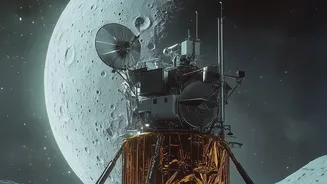
The most likely path forward for powering a lunar base is not a choice between solar and nuclear, but a combination of both. The strategy involves creating a resilient lunar microgrid. Solar arrays, deployed on sunlit ridges, would generate the bulk of the power during the long lunar day. This energy would power daily operations and charge advanced battery systems to help bridge shorter periods of darkness. Meanwhile, a nuclear fission reactor would provide a steady, constant baseline of power, ensuring that critical life support and heating systems never go down during the 14-day night. This hybrid approach provides robustness and reliability. If one system faces an issue, the other can provide backup, a crucial consideration when help is hundreds of thousands of kilometres away.